My Summer Experience Through the Lens of Miley Cyrus’ “Party in the USA”

By Joe Pohoryles

Unfortunately, the blog has been pretty inactive in recent months, and a big reason why is my summer internship reporting for the California Collegiate League’s Arroyo Seco Saints in Pasadena.

Living and working in Los Angeles these past couple months was an incredible experience and I am grateful for the opportunity. With all the people I met, places I’ve visited and experience I gained, it’s a summer I’ll always remember.

Cliches aside, it was a great summer, and reflecting on it, I thought there would be no better way to sum up my thoughts than through the lyrics of Miley Cyrus’ 2009 hit song “Party in the USA”:

I hopped off the plane at LAX with a dream and my cardigan

I don’t own a cardigan, but I did pack a grand total of three hoodies and zero pairs of pants. It’s Pasadena in the summer: It never dips below 60 degrees, even at night. It’s shorts all day, every day.

I did indeed land in LAX, and I suppose if you want to be sappy, I did have “a dream” as well.

Welcome to the land of fame excess / Am I gonna fit in?

For years, I couldn’t tell if the lyrics said “fame and sex,” which would have been too edgy for Miley’s Disney era, or “fame and success,” which is redundant phrasing and is too many syllables to fit.

Turns out it was “fame excess,” which ironically was not the case when I was there. Turns out the LA Metro area really is as big as they say it is, and I don’t think I encountered any famous people randomly on the street. If I did, they blended right in with everyone else.

Drake and Michael B. Jordan apparently joined LeBron James at a Sierra Canyon basketball game not too far from my apartment, but I didn’t find out until the next day, otherwise I would have tried to go.

I had the opportunity to interview Dodgers/Angels legend Mike Scioscia, but that was set up at one of the games I worked at, so I wouldn’t count it.

As for fitting in, I think I did just fine. The only time I didn’t think so was during a Fourth of July trip to Huntington Beach with a group of some of the players and a couple interns. Turns out a journalism major doesn’t look as good shirtless on a beach as a bunch of Division I baseball players; who would have guessed?

All jokes aside, the experience wasn’t as intimidating as one would expect. With a staff of mostly interns, I wasn’t the low man on the totem pole fighting for scraps. Instead we all worked together to get our stuff done, and I got plenty of opportunities to work on my craft.

Jumped in the cab, here I am for the first time / Look to my right and I see the Hollywood sign

It’s 2021, not 2009, so naturally I got into an Uber instead. It was indeed my first time in LA, but I don’t know what route Miley took from LAX. The Hollywood sign was not visible at all in my nearly hour-long drive to Pasadena, and even if it was, I would have had to look left, according to Apple Maps.

I did end up seeing the sign on an off-day trip to Hollywood. Meh, it’s letters on a mountain at the end of the day. Cool to see once given its iconic landmark status, but nothing super special. Not sure which sign is glorified more: this one or Boston’s Citgo sign, which I lived directly behind for a full year.

This is all so crazy / Everybody seems so famous

Things did feel crazy at times, having lived on the East Coast my whole life. I also never lived on my own, having to cook for myself before. I got along with my two roommates, Tommy Wortz and Lucas Banks, both fellow interns, really well and we had a great time living together. Even with the occasional craziness, both at home and at the job, I adjusted pretty quickly.

And again, Miley’s really overplaying this famous thing. I guess we didn’t run with the same social circles, but I really didn’t cross paths with anyone super famous.

My tummy’s turnin’ and I’m feeling kind of homesick / Too much pressure and I’m nervous

I never really felt homesick; I was so happy to get out here and get away. I sat at home doing mostly nothing for a full month between the end of school and the start of this internship, so I was itching to get out and get to work.

There were some pressured situations, but nothing beyond hitting deadlines and other work-related things that I’m used to already. Doing postgame on-camera interviews was definitely nerve-wracking at first, but I got more and more comfortable with each one.

That’s when the taxi man turned on the radio / And the Jay-Z song was on (3x)

Didn’t ever turn on the radio in the first Uber from the airport; Tommy, the driver and I mainly discussed the scene in LA, supporting the Lakers vs. Clippers among other things.

Music still played a big part of the trip. I often listened to my Summer playlist in the car or at the beach. (Shout-out to Kevin Cho’s “Breeze.” It’s become my favorite summertime driving song. Check out the music video and stream it from any platform).

I also played a small part in assembling the game day playlist for home games. Tommy, a student at Wisconsin, managed to incorporate Camp Randall-favorite “Jump Around” by House of Pain as the official victory song that would play at the end of every home win. With my sister headed to Madison this fall, the song grows on me more and more every time I hear it.

There were strict anti-rap/anti-explicit language restrictions on the home playlist, so no Jay-Z song ever came on. Instead, “Centerfield” by John Fogerty and “The Cheap Seats” by Alabama will forever haunt my dreams after being hammered into my brain.

Shout-out MLB Academy; they had the best stadium playlist by far. They even played Jay-Z.

So I put my hands up, they’re playing my song / The butterflies fly away

Not much to say here, other than reiterate that “Centerfield” and “The Cheap Seats” are the cheesiest summer baseball songs ever and I hope to never hear them again. So no, they’re not playing my song.

I can also reiterate that I was never super anxious or nervous during this job; it all felt relatively familiar. I had to get more comfortable doing things (see: on-camera work), but never really had any butterflies. That was a pleasant surprise.

I’m noddin’ my head like yeah / Movin’ my hips like yeah

Getting to cover First Team All-CCL Third Baseman Drew Cowley’s three-run walk-off home run on July 8 had my head nodding. In fact, in every on-camera interview I had to internally remind myself to quit nodding my head so much (I often forgot).

Not sure I ever “moved my hips like yeah,” but I did my best to stay in shape at the nearby gym the team and staff had access to through the summer. I at least got to do some hip exercises there.

I got my hands up, they’re playing my song / they know I’m gonna be ok

“This town ain’t big, this town ain’t small. It’s a little of both they say.”

“Hey ump, a blind man could have made that call.”

I know what you’re thinking, and no, these aren’t lines from world-renowned poet, the late great Maya Angelou. These are actually two separate lines from the first verse of “The Cheap Seats” by Alabama. Such a way with words… yeah, again, this is NOT my song.

I am not ok.

Yeah, it’s a party in the U.S.A. (2x)

I worked a lot; between travel on away games and work I had to do pre/post game, I’d be working anywhere from eight to 14 hours a day. Getting to cover this team, interacting with the players and creating quality content all while getting to explore the best parts of Southern California on my off days all confirmed that this is the work I want to do, even if the hours do stack up at times.

It may be a stretch to call this job “a party,” but there really is nothing like the view from the cheap seats.

But for real, f*** “Centerfield” and “The Cheap Seats.”

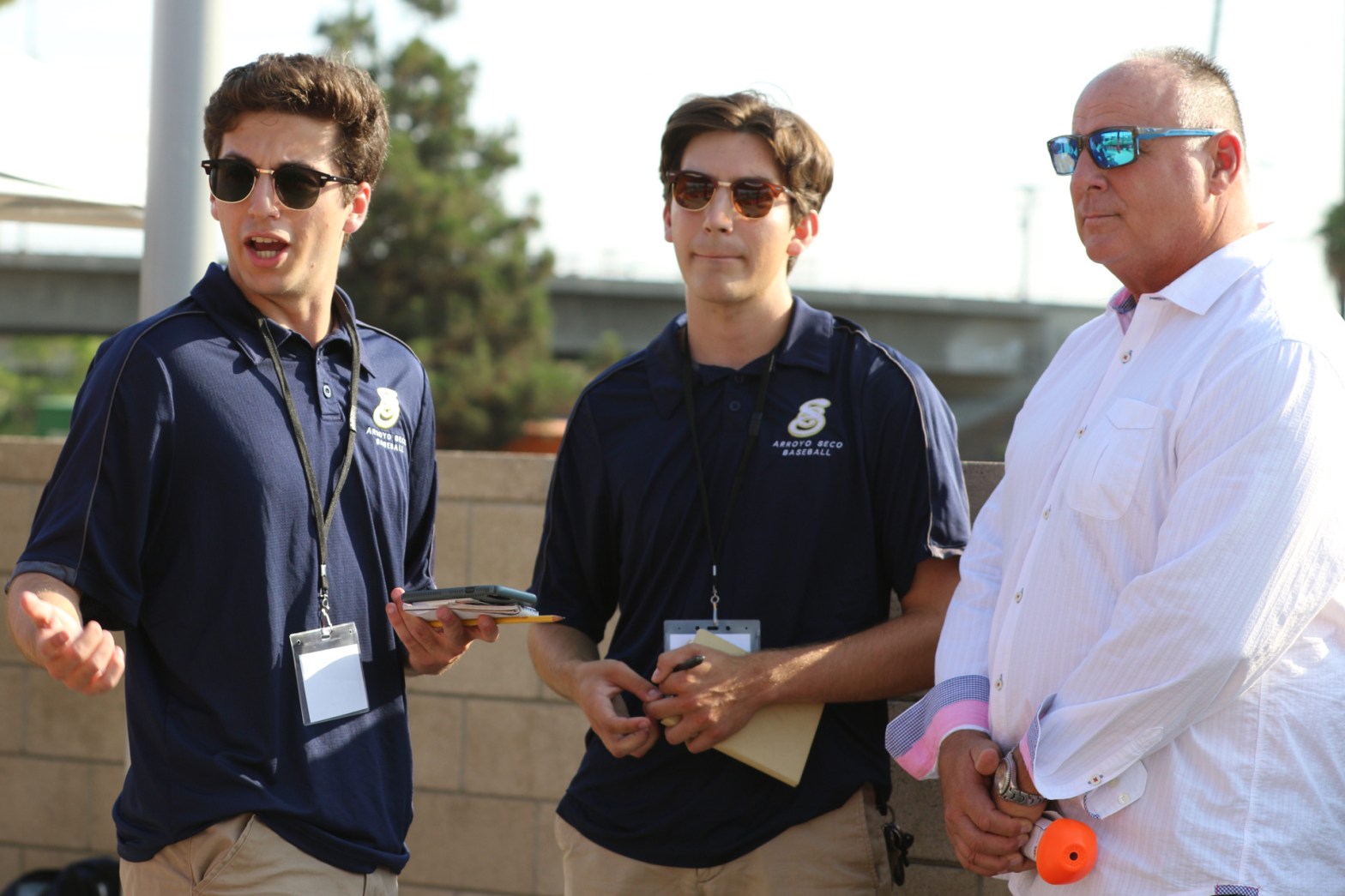
Cover Photo Credit: Angela Martinez/Arroyo Seco Saints Baseball

Chasing Gretzky 8: The Final Countdown

By Joe Pohoryles

Alex Ovechkin is here to stay!

The Great 8 signed a five-year/$47.5 million deal that will pay him $9.5 million per year until the 2025-26 season. He’ll be nearly 41 years old by the end of the deal, which is a lot of term and money to dedicate to a player of that age. This is also Alex Ovechkin.

He won’t be the player he was at 23, or perhaps even the one he is right now, but Ovechkin has defied the typical aging processes this long, so hopefully it won’t be too bad in five years. Even if it is, he is the franchise. To see him play in another NHL uniform would be unthinkable. The days of Stanley Cup contention may soon be over (if they aren’t already), which means there is one conquest Ovechkin and the team appear to be focused on.

Yes, the explanation behind this offseason Chasing Gretzky, not on the eighth of the month, is the implications behind this new contract and what it means for the record chase and the franchise. It’s only fitting that this monumental checkpoint comes in the eighth installment of this series.

To start, let’s break down the bones of this deal. I was fully expecting a four-year deal paying between $10-11 million a year. Four years would match up with the rest of Nicklas Backstrom’s term, likely signaling the end of an era. Instead, Ovi signs for an extra year and remains at a $9.5 million cap hit.

Ovechkin has said he’ll head back to the KHL in Russia when his Capitals/NHL playing days are over, so it’s safe to say that’ll be his next stop when his contract is up in 2026. Assuming there’s no change of heart or forced trade, Ovi should end his NHL career as a Capital and only a Capital.

If we cap the goal chase at the end of this contract, Ovi will need to average 33 goals per season in his late 30s. If anyone can do it, the Great 8 can, but he won’t be able to miss much more time, whether it’s his fault or not.

With the games canceled due to the 2004/05 and 2012/13 lockouts plus the impact of the COVID-19 pandemic, you could argue Ovechkin has missed out on nearly 100 career goals, or at the very least would be fast approaching 800. To be at 800 with five years left, Ovi would need to average 19 per season; a cake walk that would likely see him take it in 2023-24, the third year of his contract.

Alas, we’re stuck at 730. 165 away from the record. 33 goals in 2021-22 seems easily attainable. 33 goals at 40 years old in 2025-26? Even with Ovechkin, that seems like a big ask. Ovi is gonna have to get ahead of the count to take some pressure off his future self.

Another 50 goal season would be incredible this year. Realistically, 40-45 seems like an ideal benchmark. In fact, getting 80-90 goals over the next two seasons would go a long way.

To project forward: let’s assume Ovechkin scores 85 more goals across the next two seasons. That would give him 815 all-time, 14 ahead of Gordie Howe for second-most all-time.

With three years left on his contract, Ovechkin would need to score exactly 80 more to pass Wayne Gretzky, or 27 goals per season.

If Ovechkin can manage to score 30-35 goals at age 38, that would require him to average 23-25 goals over the final two years.

By scoring 25-30 goals at age 39, Ovechkin would need between 15-25 goals in the final year of his contract to break the record.

There’s a lot of conditions, and a lot would have to break right, but I am confident a 40-year-old Ovechkin would be able to score 15-20 goals in his age 40 season. It’s these next two to three years that are crucially important, so he can put himself in the position to need just 15-20.

I just threw a lot of hypothetical numbers on the page, but the reality is this journey has to be taken one season at a time. No matter what he does in 2021-22, we’ll have to readjust our expectations, for better or worse. A dud of a season could signal the end of the road before we even get to Year Two or Three.

On the bright side, if Ovi falls behind pace and finishes 2025-26 roughly 20 goals or so behind the record, I’d be shocked if he didn’t re-sign for one more year to go after it.

That makes me wonder how the organization will work with him. Having Ovi break a seemingly unbreakable goals record wearing a Capitals uniform would fall right behind a Stanley Cup in terms of franchise victories. To have a franchise star of 20-plus years achieve that would be quite the moment.

The harsh reality is I have a hard time thinking a team paying the following players will form a playoff contender: a 39-year-old Oveckin $9.5 million, a 37-year-old Backstrom $9.2 million, a 35-year-old John Carlson $8 million, a 38-year-old TJ Oshie $5.75 million and a 33-year-old Evgeny Kuznetsov $7.8 million. Unfortunately, that is what the Caps will be doing in 2024-25, the second-to-last year of Ovechkin’s contract.

Even if Kuznetsov is traded before then, I’d expect Tom Wilson to be on a new contract, and up-and-comers Connor McMichael, Alex Alexeyev, Hendrix Lapierre and others will be in the first year or two of their first non-entry level contracts by then.

Those latter three will hopefully represent the new wave, but regardless, if the team is no longer a playoff team by the end of Ovi’s contract, it’s fair to wonder if management will focus on surrounding him with players that will help him get to the record. Shelling out a good amount of cap to play with a high-assist center and winger could be in the cards if winning a Cup isn’t a priority.

The team may not win as much, but Ovi can chase the record and the team can gather better draft picks and prospects to build once Ovi and Backstrom are gone. The team should obviously compete for the playoffs and more as long as they can, but I wouldn’t hate taking that route if and when the winning days are over.

Even as it seems a flurry of stars are leaving DC (more on that in an upcoming post), it’s comforting knowing the city’s biggest star is here to stay.

Cover Photo Credit: Nick Wass/AP

Unpacking the Caps Protected List for the 2021 NHL Expansion Draft

By Joe Pohoryles

The 2021 NHL Expansion Draft is coming in two days, and the Seattle Kraken will soon have their first roster of players. The protection list deadline for the rest of the league (minus Vegas, who is entirely exempt from the draft since being an expansion team themselves just four years ago) recently passed, and the Capitals’ list looks like this:

Forwards:

Nicklas Backstrom (No-Movement Clause)

TJ Oshie

Evgeny Kuznetsov

Tom Wilson

Anthony Mantha

Lars Eller

Daniel Sprong

Defensemen:

Dmitry Orlov

John Carlson

Trevor van Riemsdyk

Goaltender:

Ilya Samsonov

First, we’ll address the protected players:

I was only surprised by two names on this list: Sprong and van Riemsdyk. Sprong has displayed top-end scoring ability in limited minutes. At 24 years old, he’s one of the few young players on the roster and has a chance to establish himself as a solid middle six winger for years to come.

That said, Conor Sheary had a better all-around season and was re-signed for two years with a $1.5 million AAV. The 29-year-old was a pleasant surprise as a last-minute addition for the 2020-21 Caps, and he’s now locked in as a quality third line winger for the next two years.

His playoff performance was poor, but he still projects as a key part of the bottom six, assuming he stays in Washington. The final forward spot came down to Sheary and Sprong, so I’m not totally shocked it went to Sprong. There are two good reasons why the Caps protected Sprong over the more-proven Sheary, but more on that later.

The bigger surprise was TvR. van Riemsdyk didn’t even crack the top six defensemen in 2020-21, but often filled in well as an injury replacement. There was even debate as to whether or not he should fall out of the lineup once the Caps got healthy for the playoffs.

Even with the solid performance, one would think the Caps would prioritize top-four blue liners like Brenden Dillon or Justin Schultz. There’s a major reason for Sprong and TvR’s protection, which I’ll get to shortly.

To dispell any panic about a name noticeably absent from the forwards list, Alex Ovechkin is an unrestricted free agent, and if picked by Seattle, would not have to sign there if he wanted to play elsewhere.

Ovechkin has expressed a desire to return to Washington, the Caps want him back (and are willing to overpay), and Seattle GM Ron Francis knows it would be dumb to waste a pick on a star who won’t even bother signing. The Caps did the same thing with Oshie in the Vegas Expansion Draft.

Speaking of Oshie, a homecoming isn’t in the books for the 34-year-old winger. Many speculated Oshie would be left unprotected due to his current contract paying him “top six forward” money into his late 30s.

The Mount Vernon, WA native would have been a perfect candidate to be the Kraken’s first captain, and the Caps would get over $5 million in salary cap relief. Despite that, he has proven to still be among the Caps’ most productive forwards, and losing him for nothing would be a major blow for this team.

Anyway, unless Ovechkin decides to pack it in and go to Russia, he’ll be back with the Caps again next season, in what I assume will be a four-year deal with an AAV between $10-11 million. I wouldn’t be surprised if the two sides have already agreed to terms and are waiting until after the draft to put pen to paper.

Some fans may also be disappointed Kuznetsov is protected, after his decline in play and general off-ice storylines. (If you had told me before the season that one NHL player would end up on the COVID-19 List twice this year, Kuzy would have been my first guess.)

Truth is, as much as it would help to free up his $7.8 million in cap space, losing a top-six center for nothing would sink this team. Kuzy certainly isn’t playing up to his price tag, but the team is better off making a trade to get 50 cents on the dollar than just giving the proverbial dollar away. It would be nice to get a top-six center in return, but I don’t have high hopes for the return in any potential Kuzy trade.

Finally, the reasons Sprong/TvR were protected:

The cap space references for Oshie and Kuzy are not insignificant. As has been the case for years now, the Capitals are pressed very tightly against the salary cap. The expansion draft presents a unique opportunity to free up cap space for, well, free.

It can hurt to lose an impactful player for nothing, but if Seattle takes on a certain player and give the team more cap space, it wouldn’t be the worst thing in the world.

Sprong is 24 and carries a $750,000 cap hit. Sheary is paid twice as much and is nearly 30. Caps GM Brian MacLellan has committed to making this team younger, and his protection of Sprong over Sheary is the first step.

Freeing up $1.5 million isn’t the best case scenario here, and I truly hope both Sprong and Sheary are with the Caps next season, but a young forward with a small cap hit and strong scoring ability is an attractive target for the Kraken, so it was wise of the Caps to protect him.

As for TvR, he’s proven he can be a reliable third-pair defenseman, and with a cap hit less than $1 million, he’s even more valuable for a team strapped for cash. Dillon and Schultz are due about $4 million each next season ($3.9 million for Dillon), so freeing up that much space would be better for the team, even if it means losing a better defenseman.

Best Case Scenario

This team needs cap space, and leaving both Dillon and Schultz unprotected signal the Caps want to give Seattle as many enticing options as possible to distract from the lower cap hit players.

Dillon was inconsistent at best last year, especially in the playoffs, but he’s still a proven NHL defenseman that excels in five-on-five. Schultz had a productive season with plenty of points, but is also injury prone. Even with the downsides, either would be a good choice for Seattle.

It’s also the best case scenario from the Caps’ perspective. The blue line is crowded; even with Zdeno Chara on the way out, 21-year-old Martin Fehervary is pegged to replace him on the third pair full-time. Alex Alexeyev, another 21-year-old, is not ready for a full time role yet, but is expected to get called up here and there. This all comes from MacLellan.

On top of Fehervary coming in to essentially replace Chara, Michal Kempny will be coming off long-term injured reserve. With Orlov, Dillon, Kempny and Fehervary all left-shots, one has to go. With Carlson, Schultz, Nick Jensen and TvR on the right side, another will have to go from that crop as well.

A trade will be necessary somewhere down the line, but to have one of Dillon or Schultz (or even Jensen, but I doubt Seattle goes that route) taken off the Caps’ hands will be a good thing.

I’d also be happy with Seattle taking Carl Hagelin. While he’s still a speedy winger who excels on the penalty kill, his $2.75 million cap hit is ridiculous for a guy who’s now exclusively a fourth-liner.

That said, given his fit with Nic Dowd and Garnet Hathaway that made them the Caps’ best line in the postseason, keeping him around may be worth the added expense. I also highly doubt Seattle would want to take on his contract given his current role/abilities. He should be safe.

The worst case scenario would be Seattle weaseling their way into Ovechkin’s negotiations, striking up a massive deal to steal him away from Washington and then he surpasses Gretzky’s goal record as Seattle’s first captain.

Assuming that nightmare doesn’t come close to happening, the worst case scenario is the Kraken selecting Vitek Vanecek. Some have criticized Samsonov’s maturity (him and Kuzy have been the new Dumb and Dumber these past couple years), and mistakes like the one that lost the Caps Game 3 in the 2021 First Round have turned people against him.

Fact is Sammy is more talented and has a higher ceiling than Vanecek. Vanecek was a reliable backup when Sammy couldn’t play, but his numbers weren’t great enough to warrant his protection. Losing him would still be devastating.

A player of his caliber is replaceable, but his cap hit certainly isn’t. Vanecek is making just shy of $717k next season, so if Seattle takes him, not only do the Caps lose a young netminder with room to develop into someone better, but the team also doesn’t get back any useful cap space.

Seattle reportedly has their eyes on Florida’s Chris Driedger and Dallas’ Ben Bishop, and Montreal’s Carey Price was left unprotected due to his mammoth of a contract, but they still need a young, cheap third goalie behind whichever two they end up taking from elsewhere. They could do much worse than Vanecek.

It will be tough to part ways with pretty much any player in this expansion draft, but losing VV would be a disaster for cap reasons and goalie depth. The 21st will be nerve-wracking, but Caps fans should hope it’s Dillon or Schultz shipping out to the other Washington.

Cover Photo Credit: Patrick Smith/Getty Images

What to look for in Caps-Bruins series after Game 1

By Joe Pohoryles

The Capitals opened the 2021 Stanley Cup Playoffs against the Boston Bruins last night, where goals from Tom Wilson, Brenden Dillon and Nic Dowd pushed the Caps to a 1-0 series lead. Despite the positive start, a tough series lies ahead.

The biggest concern comes in net, as Vitek Vanecek had to exit in the first period due to a lower-body injury. With Ilya Samsonov not quite ready to suit up after just coming off the COVID absence list, the almost 40-year-old Craig Anderson jumped in.

Anderson’s last playoff appearance was with the Ottawa Senators in 2017, where he backstopped the team to the Eastern Conference Finals. The 18-year NHL veteran with nearly 50 games of playoff experience was a contrast from Vanecek, making his first postseason start.

Anderson did enough to get the win, and while the goaltending was a concern even before Vanecek went out, I’m not liking this team’s prospects if they have to ride Anderson for the long haul.

Bold take, I realize, but in all seriousness, Anderson looked like a ping pong paddle most of the night, allowing high-danger rebounds throughout the game. Luckily, the Bruins didn’t capitalize, but it seems more like bad puck luck than anything else.

The Bruins missed the net 21 times, their most in a single game since 2018, and while Boston fans will be busy lamenting their own goaltender situation (*rolls eyes*), the Bruins will be studying more of Anderson’s tendencies and be better prepared to position themselves in the right places for the inevitably juicy rebounds.

The goaltending situation looks rough (for us, just to clarify. Not for the whiners with a future Hall of Famer in the crease), but to avoid dwelling on the negative, the Caps will give themselves a solid chance to pull out another win no matter who’s protecting their net if they continue these two things:

  • Shutting down Boston’s top six
  • Laying on more big hits

These are both overwhelmingly obvious keys to stopping any team, but Boston’s top six is as good as any in the league, and it was largely a non-factor in Game 1 besides Taylor Hall drawing a couple power play opportunities for the B’s.

Additionally, Patrice Bergeron had a field day on the face-off dot and David Pastrnak had multiple oh-so-close chances on the doorstep (he’ll be cashing in sooner or later), but overall, the Caps did a solid job shutting them down.

The Bruins won’t miss the net 21 times again, but if the Caps can continue limiting Brad Marchand’s impact to pre-game charitable gestures, then they’ll be able to level the playing field.

That task is much easier said than done, but the second point goes hand-in-hand with it. The Caps were punishing the Bruins physically from the get-go and that has to continue. The Bruins got some good hits in of their own, but the Caps have to continue to set the tone and wear the opponent’s down. I’m excited to see how both teams respond in Game 2.

Coming in, I had Boston winning in five or six games. The additions of Hall, Curtis Lazar and Mike Reilly have all had positive impacts, to varying extents, and I just don’t see the Caps, lacking in center-depth and goaltending, keeping up. I hope I’m wrong, but I still see Boston winning in six.

Three Caps Game 1 Highlights:

Craig Anderson– I went into detail about my concern about him going forward, but he deserves props for stepping in with little preparation and getting the win in Game 1.

Tom Wilson– Even if you ignore his gorgeous top-shelf goal (and why would you?), Willy was the best all-around player last night, in my opinion. He was confident in the offensive zone, looking strong on the puck and creating numerous chances. He also was as physical as usual in the defensive end. With Evgeny Kuznetsov out and TJ Oshie working back from injury, Wilson is stepping up at the right time.

Conor Sheary– Sheary continues to pay major dividends on a minimum contract. His forechecking game was on point, and I loved his overall aggression and puck movement. As far as third-line production goes, Sheary looks like he could be 2021’s version of Brett Connolly.

Three Caps Game 1 Lowlights:

Anthony Mantha– ‘Lowlight’ may be the wrong word here, but I do want to see more from him in general. He has no goals since his four-game goal streak to open his Capitals tenure, and while he’s contributed assists, we can’t have a 2019/2020 playoff Jakub Vrana repeat on the second line.

John Carlson– Hopefully he’s just shaking off some rust after missed time, but he committed a handful of sloppy turnovers in both zones throughout the game. He’s gotta clean things up.

Evgeny Kuznetsov/Ilya Samsonov– They can share this title, since they seem to love sharing plenty of other things. I don’t think anyone knows exactly what’s going on with these two, as some sources speculated management is done with Kuznetsov and he’s played his final game in a Caps uniform, but it looks like he’s close to coming back, if the playoff run lasts long enough.

Whatever the case, the Caps would be much better off with these two contributing, and they wound up unavailable at the worst possible time. Can’t be letting the team down in playoff time.

Cover Photo Credit: NHL.com

Chasing Gretzky VII: The Russian Machine Broke

By: Joe Pohoryles

After a year of so many setbacks in the chase to 894 career goals, the seemingly unfathomable happened to make the road even more difficult: Alex Ovechkin got injured.

Not including a 39-second shift on May 3 that was more of a test run than anything else, Ovechkin has not played since April 22, and he’s likely done for the regular season. Barring an appearance on May 11, the final game of the 56-game schedule, Ovechkin will finish the season with 24 goals in 44 games (or 43 games plus the aforementioned 39 seconds).

That leaves him exactly one goal behind Marcel Dionne’s 731 career goals, stuck at sixth on the all-time list. At his pace prior to the injury, Ovechkin was expected to be sandwiched between Dionne and Brett Hull in the fifth slot. Instead, we wait.

I projected Ovechkin to finish with around 28 goals this season had he remained healthy, so ending with 24 isn’t a complete train wreck, but it allowed fewer opportunities for Ovechkin to make up for lost time. A torrent stretch to end the year, pushing him into the low to mid-30s would not have been out of the question, but it wasn’t meant to be.

For the Capitals, it’s smart to just hold him out until the playoffs. He was even on the ice today for an optional skate, so he should hopefully be ready to go by the first round. It’s the right move, but it definitely hurts the goal record chase.

Prior to this recent injury, Ovechkin had missed just 35 games in his entire career, and only 17 due to injury. Now it appears he’ll miss the final nine games of an already shortened season (only eight if you don’t include the 39 seconds on May 3), all due to injury.

With all the missed time, there isn’t much to report over the past month. He added four more goals on to his season total, and now rests at 730 total. Assuming there’s a full 82-game season next year, he should be able to pass Dionne, Hull and even Jaromir Jagr to finish 2022 third on the all-time list. Of course, that also assumes he won’t miss extended time with injuries, which for 16 years had been nearly a given.

Now that he’s nearly 36 and entering Year 17, is the Russian Machine finally reaching a breaking point? With his 13-year mega contract expiring this summer and no solid plans in place for the future, the Capitals and Ovechkin need to come to terms on an extension first.

Assuming he stays in Washington and his body doesn’t give out on him, the 2021-22 season will be a prime opportunity to make progress on the chase. He has faced every setback imaginable this year, and with every chunk of missed time, the hope for passing Gretzky dwindles.

Looking ahead in this final installment of the season, a strong make-up performance next year will be extremely necessary. To get back on track for 2022 and beyond, passing Jagr by a handful of goals should be the target.

For now though, as the postseason approaches, Caps fans can hope for Ovechkin and the rest of the team to get healthy in time for the first round, and hope that this roster has what it takes to face any challenger, hopefully resulting in another Stanley Cup. The window for Ovechkin passing Gretzky may look small, but the team’s Stanley Cup window is even smaller.

The lineup is a mess right now, but we’ll see what happens in a little over a week.

Cover Photo Credit: TSN/The Canadian Press

2021 NFL Draft Reactions

By: Joe Pohoryles

The 2021 NFL Draft is underway, and the Washington Football team will be adding their newest crop of players to fill any holes in the roster and try to improve from last year’s 7-9 record. Follow along as this post will get updated over the next few days.

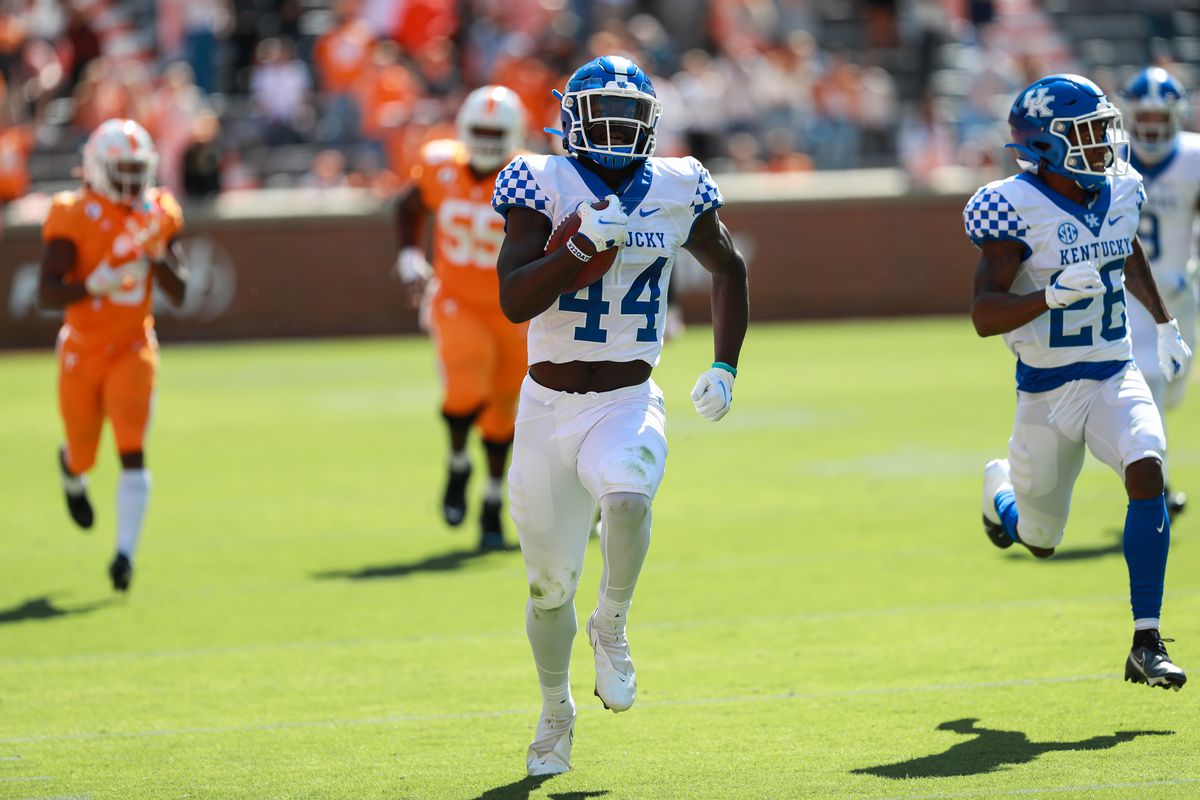
Round 1 (19)- Jamin Davis, LB, Kentucky

With five quarterbacks taken in the first 15 picks, Washington was in prime position to take a stud prospect that slipped further than they should have. Virginia Tech offensive tackle Christian Darrisaw and Notre Dame linebacker/Swiss Army Knife Jeremiah Owusu-Koramoah were among the top players in positions of need. Darrisaw could be a starter at left tackle from Day One, and Owusu-Koramoah is a weapon that could be deployed in a bevy of defensive packages.

Instead, Washington opted for linebacker Jamin Davis from Kentucky. Most mock drafts had him going in the mid-20s, with some even having him slip to the second round, but Washington felt good enough about him to take him at 19. Davis should help shore up the linebacker corps immediately, and despite starting just one season at Kentucky, he fills a major hole at inside linebacker.

Head coach Ron Rivera and general manager Martin Mayhew rated Davis as the best defensive prospect in the entire class, and while some say it was a reach, I trust Rivera and defensive coordinator Jack Del Rio (former linebackers) as well as VP of player personnel Marty Hurney (drafted Luke Kuechly) in evaluating linebackers.

Davis is an athletic freak and should do a lot of damage behind the team’s elite front four. Just look at these numbers:

After totaling just 32 tackles in 2019, Davis garnered 102 in 2020 (T-7 in FBS) as well as three interceptions. The upside is tremendous, and I even suggested Washington take Davis with their first pick in an NFL Draft segment on the show Offsides at BUTV10 (albeit, I said they should trade back):

http://www.butv10.com/shows/off-sides/#vid=540181446

(Segment is 17:30-24:00)

Even with Owusu-Koramoah still on the board, Davis looks like a great pick that plays a more traditional linebacker role than JOK. And with the Notre Dame linebacker still on the board entering Day Two, maybe he’ll slip to 51…

Probably not, but I also didn’t think he’d slip to the second round, so we’ll see what happens.

More realistic players to watch on Day Two are quarterback Davis Mills (Stanford), offensive tackles Liam Eichenberg (ND), Walker Little (Stanford) and Spencer Brown (NIU) and defensive backs Elijah Molden (Washington) and Andre Cisco (Syracuse).

Round 2 (51) – Samuel Cosmi, OT, Texas

With Morgan Moses, Brandon Scherff and Chase Roullier holding down the right side of the offensive line and the center positon, respectively, and Ereck Flowers coming back on board to pick up where he left off at left guard, the biggest question mark on the offensive line is left tackle.

Question no more: Samuel Cosmi, who many mocks had going late in the first round/early in the second, will have the opportunity to compete right away. Cornelius Lucas was quietly solid last season, and will have every opportunity to keep the starting job, but Cosmi should eventually develop into the full-time starter.

Cosmi has experience at both left and right tackle, and much like first-round pick Davis, is an athletic beast. At 6’7″ and 320 pounds, he had a RAS score of 9.99 (out of 10.00), which measures how athletic a player is. His score is the second-highest of any offensive lineman from 1987-2021.

Reports say he needs to be coached up a bit and was mismanaged at Texas, but in the proper hands, he has all the raw skill to develop into a great tackle.

Round 3 (74) – Benjamin St-Juste, DB, Minnesota

People were confused by this pick, as was I. There were other defensive backs on the board perceived to be better (including Molden, who I had listed as a possibility after Day One), but the Canadian Benjamin St-Juste was the pick.

I had not heard of him before the pick, and it seems many experts in the Washington scene had not looked at much film for him, but the corner’s 40-time (4.51) has some thinking he isn’t fast enough to play corner in the NFL, and that he may slide in at free safety, which is now the biggest hole on defense.

No matter where he’s played, this definitely seems like a risky pick with upside. We won’t know exactly where he’ll slide in, but even with the addition of William Jackson III in free agency, the secondary needed a boost, so hopefully St-Juste will provide that.

Round 3 (82) – Dyami Brown, WR, North Carolina

We’ll see what happens on Day Three, but Dyami Brown is the early favorite for biggest steal of the year (among Washington’s picks at least). Not everyone had a first-round grade on him, but snagging him at 82 is a bargain no matter how you slice it.

Once viewed as a weakness, the wide receiver corps headlines Terry McLaurin, Curtis Samuel and now Brown. Adding in Adam Humphries as a reliable slot guy, plus Logan Thomas at tight end and JD McKissic out of the backfield, I’d say it’s a strength.

Brown had over 1,000 receiving yards in each of the past two seasons. Brown should be able to line up anywhere and excels in the yards after catch (YAC) category, averaging over 20 in each of the past two seasons as well. His route running can improve, but isn’t a weakness, and if he reaches full potential, Washington may have found themselves yet another third-round steal.

Round 4 (124) – John Bates, TE, Boise State

Washington doesn’t have any tight end depth to speak of behind Thomas, so John Bates should make an impact right away. The team also signed Chilean superhuman Sammis Reyes at tight end, but he’s more of an unpredictable project.

Bates has a good frame (6’5″ and 250 pounds), which suggests his solid blocking ability should translate in the NFL, and Washington could use that. Additionally, he should generate some receptions up the middle, but won’t be a target machine, especially with all the new faces in the receiving corps.

Bates doesn’t project to be a superstar, but he has the potential to be a serviceable tight end that blocks well and can catch a few passes when you need him to, and that’s all you can ask for from a fourth-round tight end.

Round 5 (163) – Darrick Forrest, S, Cincinnati

Washington struck gold when they selected Kamren Curl on Day Three last year, and with the need at free safety, is it possible Forrest is the guy to exceed expectations this year? Probably not, but he should at least provide depth.

He has experience playing in multiple packages at Cincinnati, and should be able to challenge Troy Apke and others for playing time on special teams.

Round 6 (225) – Camaron Cheeseman, LS, Michigan

The Green Bay Packers messed up big time by not drafting Camaron Cheeseman, but I’m sure glad Washington snatched him up. Washington was in the market for a long snapper for the first time in over a decade after Nick Sundberg went unsigned this offseason.

Sundberg, who had been on the team since 2010, was the longest tenured player on the roster last season. Now Cheeseman comes in with an entirely clear path to take over long snapping duties. Among the best in the country (and yet, not even the first taken in the draft — Carolina took Alabama’s Thomas Fletcher three picks earlier), Cheeseman has the chance to become a fan favorite early on.

If he remains consistent, Cheeseman will hopefully follow in Sundberg’s footsteps and stick around for over 10 years.

Round 7 (240) – William Bradley-King, OLB/DE, Baylor

Round 7 (246) – Shaka Toney, DE, Penn State

As seventh-rounders, William Bradley-King and Shaka Toney are far from sure things, but both have potential to develop into backups for Chase Young and Montez Sweat. Both will be used situationally, and may also be able to contribute on special teams.

Toney especially seems like a prime special teams player, at least to begin his career. His 4.55 40-speed will be crucial in special teams situations, and his 5.0 sacks last year led the Nittany Lions, proving he can get after the ball carrier and finish the job. He was projected to be a mid-round pick entering the draft by some outlets, but his size (6’2″) could be part of the reason why he dropped.

Either way, with Young and Sweat in front of them, these two should have a chance to compete for a reserve spot.

Round 7 (258) – Dax Milne, WR, BYU

BYU’s Zach Wilson went second overall in this year’s draft, so it’s oddly poetic that his top receiver last year went second-to-last. Just one spot shy of being Mr. Irrelevant, Dax Milne is coming off a 70-1,188-8 season in Provo.

Even with his strong final season, Milne may not be a factor in the receiving game, and is far from a guarantee to make the roster. There are some established receivers from last year that may not make the roster this year (I’m looking at both Sims), so any impact Milne has will likely be limited to special teams if he makes the cut.

UDFA – Jaret Patterson, RB, Buffalo

Jaret Patterson’s claim to fame is his 406-yard, eight touchdown game against Kent State on Nov. 28 that tied the FBS single-game record for rushing touchdowns. The Glenn Dale, Maryland native returns to Prince George’s County where he’ll be competing with Peyton Barber, Lamar Miller and Jonathan Williams for a spot in the backfield behind Antonio Gibson and McKissic.

Patterson was also high school teammates with Young at St. Vincent Pallotti for two years before Young transferred to DeMatha Catholic as a junior.

None of Washington’s picks looked glaringly bad, and Brown, Cosmi and Toney all seem like good value picks. Quarterback wasn’t address, but multiple other needs were filled. If I had to grade the class, I’d give it a B+, but of course we won’t know how well this class performs until the season kicks off.

If this class can hit the ground running just like the 2020 class, Washington should be in very good shape to repeat as division champions, and hopefully even more.

(Cover Photo Credit: Jacob Noger/Collegiate Images/Getty Images)

DC United kick off their season against NYCFC

By: Jonathan Yuhas

DC United begin their 2021 MLS campaign against New York City FC. This season appears to be a long trek for United, but is laced with some optimism.  In the last five matchups between DC and New York City, NYCFC has prevailed in every game. The last meeting between these two was an MLS fixture that ended with a 4-1 score in favor of New York City.

Things to know before match day:

DC United will be without three of their projected starters. This list includes Steven Birnbaum, Felipe Martins, and star forward Paul Arriola. Arriola returned from his loan to Swansea after a quadriceps injury that will have him out for 4-6 weeks. United’s tremendous midfield depth will help offset the loss of Martins and Arriola, but the back line may suffer without Birnbaum.

United will continue with the question mark they had in 2020, trying to figure out their identity moving forward. Early this season, United will have a common word in their vocabulary: “Youth.” Moses Nyman, Kevin Parades, and Griffin Yow made up a potent trio of youngsters that received a lot of crucial development time in 2020. DC also added 19-year-old Venezuelan forward Jovanny Bolivar to the mix.

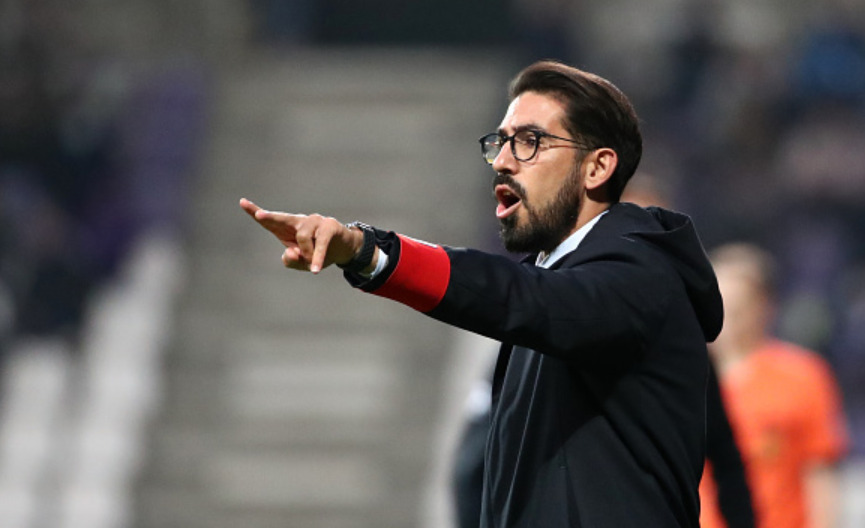
Players are not the only element of United’s youth. Making his debut as manager, Hernán Losada seeks to make his mark. In his first interview as United’s manager, Losada made his strategy pretty clear: He seeks to have United go forward often when he said, “I would like to start playing as vertical as possible.”

“Based on the games I saw, you can see that the moment DC United recovers the ball, most of the time they look to play later or backward. And I do believe that the moment that you play vertical, especially after the transition, when you recover the ball, you can exploit the disorganization of the opposition.”

This vertical playing strategy will be severely tested against a strong opponent like NYCFC. He may be tempted to implement a more defensive approach to get a draw on opening weekend.

On that note, New York City FC made some very strong additions this offseason, making an already great team even better. NYCFC added United States men’s national team youth player Chris Glouster, who was very impressive in the Bundesliga 2 with Hannover 96 and with PSV 2 in the Eredivisie.

They went on to add even further US Men’s national team talent in Alfredo Morales, who had recently been making starts for the Yanks and was a consistent substitute for Fortuna Düsseldorf, making 27 appearances in the 2020 season.  These additions give DC United a tall task on match day.

What to expect:

Overall, this match day DC United fans should expect change. Losada will be implementing his new tactics and an ideal lineup with some youngsters who will be looking to take a step up in 2021.

My prediction is that DC United will not play for results, but rather Losada will use this first match day to find an identity. United is expected to go forward a lot, even if they might not have the players necessary to do so effectively (considering the loss of Arriola).

United may be caught too high up on occasion, with New York’s efficiency up top and in the counterattacking game. Still, even with the loss of Arriola and Birnbaum, United fans have a lot to draw optimism from, especially, the debut of Losada and the opportunities United’s youth will have during this time of injury.

(Cover Photo Credit: Last Word On Sports)

Chasing Gretzky VI: Hull Speed Ahead

By: Joe Pohoryles

After one of the worst 20-game starts in his career, Alex Ovechkin has kicked things back into gear, scoring 11 goals this past month to elevate his season total to 19 in 35 games. The Great Eight now sits just six goals shy of tying Marcel Dionne for fifth on the all-time list, a mark that seemed to be a long shot just a month ago.

Shame on me for counting him out. The Caps played 15 games since Mar. 8, through which Ovechkin totaled 16 points (11g, 5a). Ovi started the season at a pedestrian 0.40 goals per game, but with his red-hot 0.73 GPG over the past month, his full-season rate is up to 0.54. This isn’t too far behind his career average of 0.61, and considering how he started the year, is the best-case scenario at this point.

With 17 games left in the Capitals schedule, Ovechkin is now practically guaranteed to pass Dionne by season’s end (barring another stoppage, due to injury or otherwise), and that didn’t seem likely just a month ago. Should he continue on this torrent pace of 0.73 GPG, Ovi will finish with 31 goals on the year and 737 total.

Looking conservatively, and assuming he regresses to the mean of 0.54 GPG, Ovi will finish the year with 28 goals and 734 total. Either way, he should be squarely between Dionne and Brett Hull by season’s end.

Speaking of Hull, Ovi reached another significant milestone on a different all-time goals list, tying Hull for second on the all-time power play goals list with 265. Both Ovi and Hull sit nine power play goals behind all-time leader Dave Andreychuk. Power play goals and scoring rates on the man-up are more difficult to project, so who knows when he’ll take the number one spot?

However, if I had to estimate based on recent history, it will take roughly 51 more games. Allow me to elaborate:

SeasonCapitals PPG/PP oppCaps PP%Caps PP opps per gameOvi PP goals% of Caps PP goals scored by Ovi
2016-1757/24723.073.011729.80
2017-1855/24422.542.981730.90
2018-1949/23620.762.881836.73
2019-20*42/21619.443.131330.90
2020-21*23/9623.962.46521.73
*not a full 82-game season

Looking over the past five seasons, we can get a general sense of how Ovechkin and the Capitals have fared on the power play in recent years. Below are the five-year averages:

  • 2.89 PP opportunities per game
  • ~237 total PP opps per 82-game season
  • 21.95 PP%
  • 30.01% of Caps PPG scored by Ovi

With those last two percentages, we learn that for each power play opportunity the Capitals get, there’s theoretically a 6.59 percent chance Ovechkin will score (30.01% of 21.95% = 6.59%). That translates to one Ovechkin goal roughly every 15 power play opportunities for the Capitals.

Taking a simple approach, that means there will be 135 power play chances for the Caps before Ovechkin ties the record (15 chances x 9 goals), and 150 chances before Ovechkin breaks it (15 x 10). There have been four power play opportunities since Ovechkin last scored a power play goal, bringing the total down to 146.

As we’ve seen, the Caps have been getting about 2.89 power play opportunities per game over the past five seasons, which means it would theoretically take about 51 more games for Ovechkin to break the record (146/2.89 = 50.52).

Of course, this is no guarantee; every power play opportunity is mutually exclusive, so he may go the next 50 games without scoring a power play goal, or he could score in 10 of the next 15 power play chances and have the record within the next five games.

That said, if things play out as they have over the past five-ish years, we can expect the all-time power play goals record to belong to Ovi less than midway through next season. Specifically, about 34 games into the 2021-22 season, assuming Ovechkin doesn’t miss any time (and given the past year, we probably shouldn’t bank on that).

Topping Gretzky on the regular all-time goals list is the only focus in this series, but after a disheartening year followed by an underwhelming stretch in February, it’s worth recognizing and celebrating the milestones like these, and we will hopefully be celebrating Ovi’s next NHL record relatively soon.

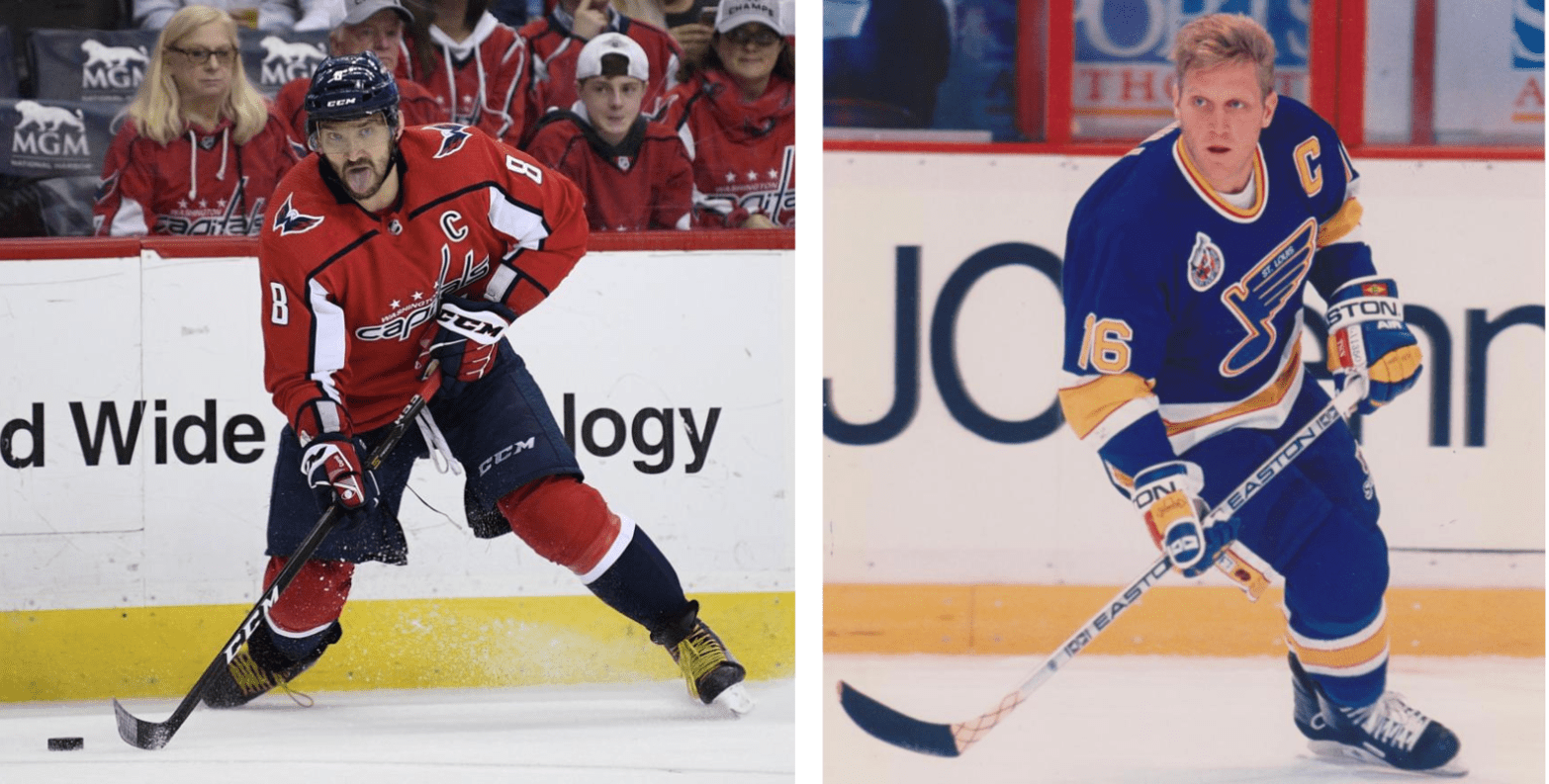
Cover Photo Credit: L – Nick Wass/AP; R – US Hockey Hall of Fame

Don’t Look Now: The Nationals Bullpen (finally) looks like a strength

By: Jonathan Yuhas

The Washington Nationals bullpen has always been a major weakness, especially in 2019 and 2020. In 2019, the Nats bullpen posted the worst Earned Run Average (6.34) in the MLB that season by a wide margin. It ranked as the sixth-worst bullpen ERA of all time. (Stats from MLB.com)

It seems as though every season, when the trade deadline comes around, the Nationals desperately seek the aid of bullpen help via trade. An example of this would be the 2017 effort of trading for Sean Doolittle, Brandon Kintzler and Ryan Madson. In 2018, the Nationals made a midsummer deal for Kelvin Herrera as well. Then in 2019, the team added Daniel Hudson, Roenis Elias and Hunter Strickland at the deadline. 

Each season these trades hardly seem to be fruitful, as only Doolittle and Hudson truly made an impact on the Nationals during their time here.

This is a trend in the District that needs to be broken, and appears like it finally will be in 2021. MLB bullpens typically carry seven relievers, so that is how I will be applying these predictions. I believe the likely Nationals 2021 bullpen goes as follows:

CL: Brad Hand

SU: Tanner Rainey

SU: Daniel Hudson

MR: Will Harris

MR: Wander Suero

MR: Kyle Finnegan

LR: Austin Voth

CL = closer; SU = setup; MR = middle reliever; LR = long reliever

There is not a single spot in this relief corps that any Nationals fan shouldn’t have a sense of optimism for. The bullpen has a perfect mix of age with veterans in Hand, Harris, Hudson and Suero to go along with the young guns in Rainey, Finnegan and Voth. Rainey and Finnegan in particular were the lone bright spots of the Nationals 2020 bullpen. Rainey posted a 2.66 ERA and Finnegan had a 2.92 ERA. Rainey had been battling an injury in 2020 but Martinez expects Rainey to 100 percent by Opening day. 

For the older guys, Hand is coming off of a phenomenal 2020 season, and the Nationals are hoping that Harris and Hudson can return to their 2019 form.

Arguably the most underrated piece of the Nationals bullpen this year would have to be Suero. He had a mediocre year last season, but the movement on his pitches is undeniably nasty. Suero’s statistics are slowly starting to improve as the years go by, and as he continues to control his pitches. He is set to have a breakout year. He is performing well in spring training and his control appears to be much better.

Look for the Nationals bullpen to break out this season as a strength. The bullpen appears to have the best depth it has had in years. All of the members of the bullpen, along with the competition brought in for this spring training, (Ryne Harper, TJ McFarland and Ben Braymer), make this bullpen all the more sturdy. Nationals fans should be left feeling optimistic, especially in our late inning options to complement our incredible starting pitching.

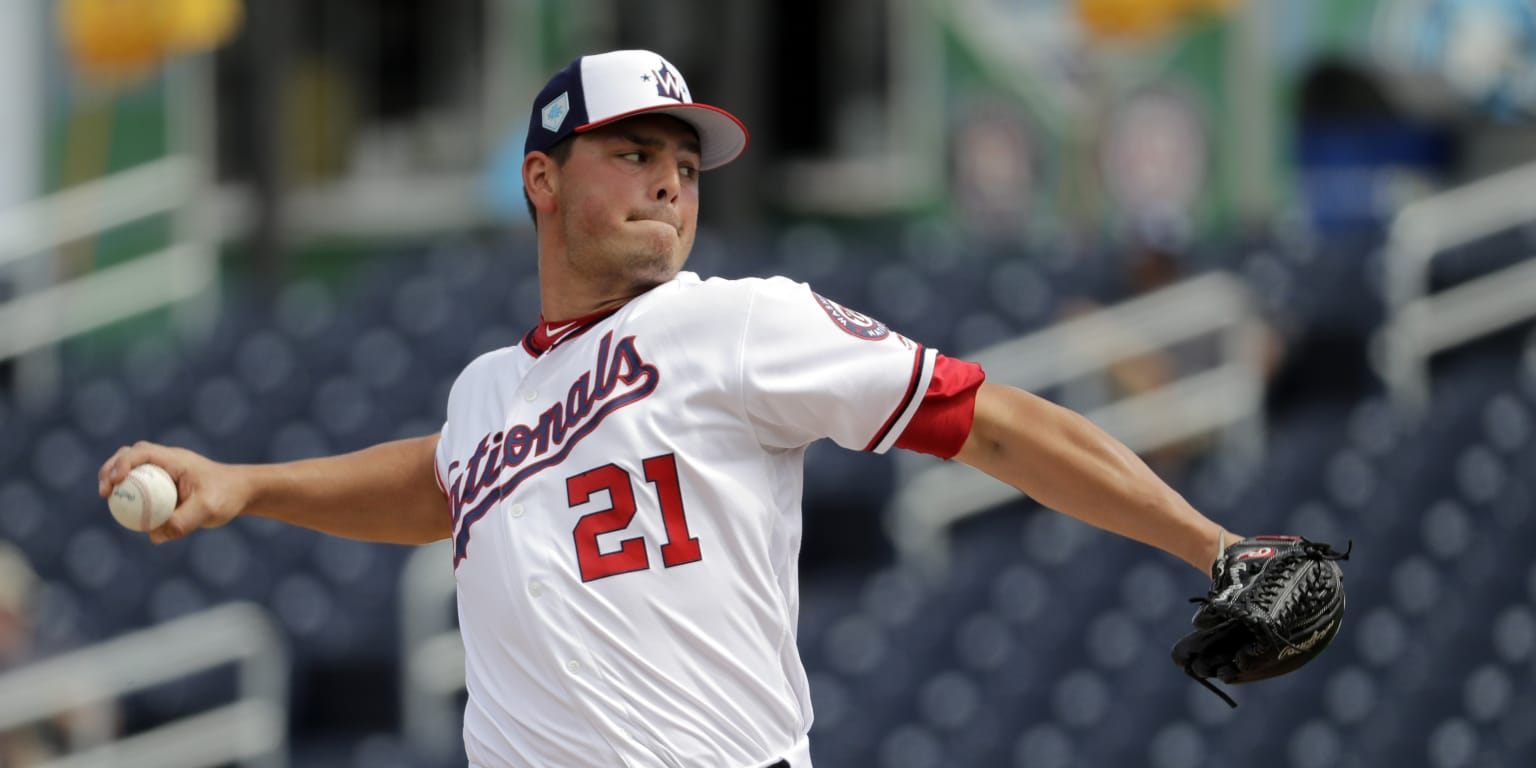
Cover Photo Credit: MLB.com

Chasing Gretzky V: Shades of 2013

By: Joe Pohoryles

Three goals in four weeks. That’s all Alex Ovechkin has scored between Feb. 8 and today, giving him a total of eight goals through 20 games. After losing so much time due to the recent shortened seasons, Ovechkin needed to ramp up his scoring pace. Instead, he’s experiencing one of the worst starts of his career.

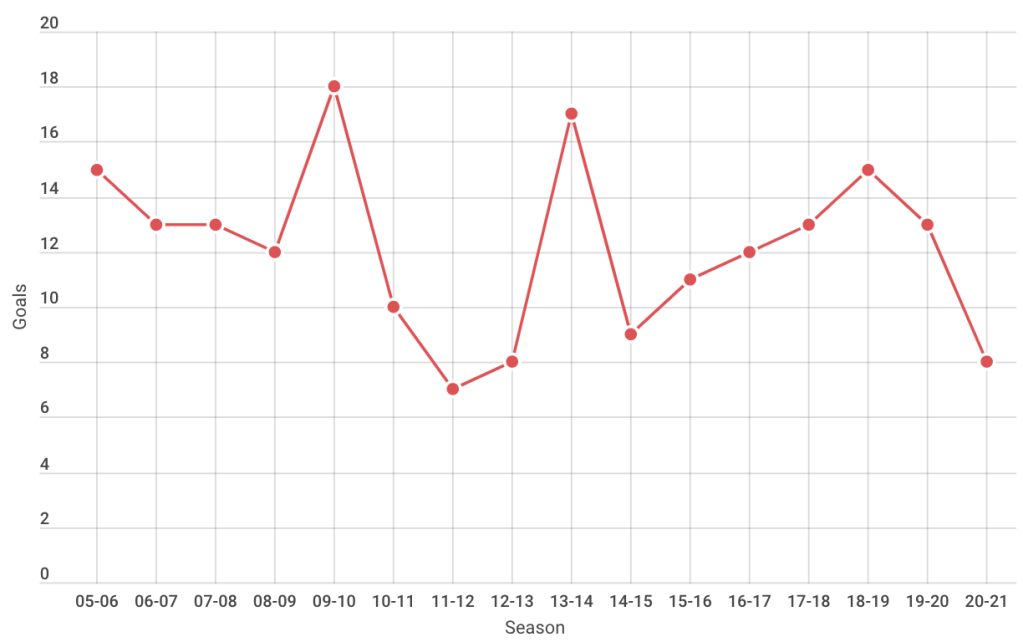
Ovechkin goals through first 20 games* each season of his career

*The first 20 games Ovechkin has played each season, not the Capitals’ first 20 games of the season. (Infographic by Joe Pohoryles)

Through his first 20 games, eight goals is his slowest start since 2012-13, when he also had just eight goals. His lowest total through 20 games was seven in 2011-12.

In a normal 82-game season, he would have plenty of time to get back on track. However, in this 56-game pandemic season in which he has already missed a handful of games, he only has 32 games left.

For a full season, Ovechkin would be on pace for about 33 goals, matching his total in 2016-17. If he plays every game for the rest of this season, he’s on pace for about 21 goals in 52 games. Not ideal.

There is precedence for a bounce back; that 2012-13 season in which he started with eight goals was also shortened, this time due to a lockout. The season had eight fewer games on the schedule than this year’s, but despite the relatively slow start, Ovechkin finished with 32 goals in 48 games to win yet another Rocket Richard (and his third Hart Trophy).

With 24 goals in the final 28 games, it’s no wonder why Ovechkin won over MVP voters by the end of the season. That ridiculous 0.857 goals per game rate pulled him far out of the slump, ending the year on pace for 55 goals in a full 82-game season.

Will we experience a similar explosion this time around? For those rooting for the record to be broken, we better hope so. This season is more a sprint than a marathon, after all, and that shorter regular season tends to help older players.

It may be unwise to expect a similar burst this time around, though. In the 2012-13 season, Ovechkin was 27 years old, which is a peak age during an athlete’s physical prime. The Russian Machine keeps on chugging, but expecting him to do the same thing eight years later at 35 seems like a pipe dream.

That doesn’t mean it can’t get better at all. Even if his scoring rate jumps up to 0.60 goals per game from his current 0.40, he’ll finish with about 27 goals. A month ago, it seemed like 30 was a realistic baseline, so while 27 would be disappointing, it wouldn’t be too far off. To reach 30 exactly would mean Ovechkin needs to score 0.6875 goals per game down the stretch.

He averaged 0.705 goals per game across all of last season (which was also shortened), so he can still put out that level of production in a shorter span. It takes one game to get hot, and if he can put together a good week, that will make a tremendous difference.

Ovechkin will hopefully pass Phil Esposito to reach sixth on the all-time list by next month, needing four more goals to pass him. Marcel Dionne sits fifth with 731 goals, meaning Ovechkin will need to finish the year with 27 goals to eclipse him.

As mentioned, ending with 27 is well within the realm of possibility, but the main target is No. 99 sitting at the top, so Ovechkin will have to make up major ground this month and beyond.

I don’t anticipate Ovechkin putting together a scoring stretch that wins him his fourth Hart Trophy, but if he can get somewhere close to that, he could help make up for the past calendar year that has greatly diminished his chances.

Cover Photo Credit: CBS Philly