New Sheriff in Town?

Evaluating whether the Nats should experiment with Stephen Strasburg as the ace

By: Joe Pohoryles

Five All-Star selections, three NL strikeout championships, two Cy Youngs and one World Series ring later, Max Scherzer sits as the most decorated pitcher in Nationals history, and among the best of his generation.

Since being acquired in 2015 free agency, Mad Max has dominated as the team’s ace, racking up individual accolades before finally capturing the highest team accomplishment in his fifth season with the team. What was initially viewed as the worst contract of the 2015 offseason quickly turned into a bargain, and Scherzer is still under contract for two more seasons.

As the Nats begin defending their crown starting on March 26, Scherzer is set to take the mound at Citi Field as the Opening Day starter for the sixth year in a row.

But should he?

Well, yes, he should. He’s as great an option as they come. He has always been the team’s ace, and assuming he is healthy and ready to go, he should be on the mound Opening Day.

So why even pose that question? Well, looking at the past six months and into the future, the decision may not be so cut and dry. It is worth wondering if it is time for the Nationals to begin transitioning Stephen Strasburg into the starting rotation’s top spot. If not for Opening Day, then perhaps later in the season.

I’ll be the first to admit this is a fairly arbitrary conflict, as the distinction between the real No. 1 and the deputy does not have much significance until the postseason. However, for a guy like Strasburg, who prefers to stay out of the limelight, it may be worth easing him into that ace spot.

These four separate events from the past six months make the ace pitching situation slightly less secure than it has been for the past five years:

July 13: Scherzer lands on 10-day Injured List

Scherzer has long been lauded for his durability. He had been on the IL — formerly known as the Disabled List (DL) — just twice entering 2019, his twelfth major league season. For 10 consecutive seasons (2009-2018), Scherzer made at least 30 starts.

On July 13, however, a mid-back strain landed him on the 10-day IL. (Note: the move retroactively started on July 10.) He returned to make one start, an 8-7 loss to the Colorado Rockies on July 25, before landing on the IL again on July 29 after reaggravating the strain.

In about two weeks, he doubled his career IL trip total. This came just a month after he won NL Pitcher of the Month for June, one of the best stretches of his career that kept him firmly in the Cy Young race. Those two IL stints may have been brief, but Mad Max looked mortal for the first time in his career.

October 1: Strasburg rescues NL Wild Card Game

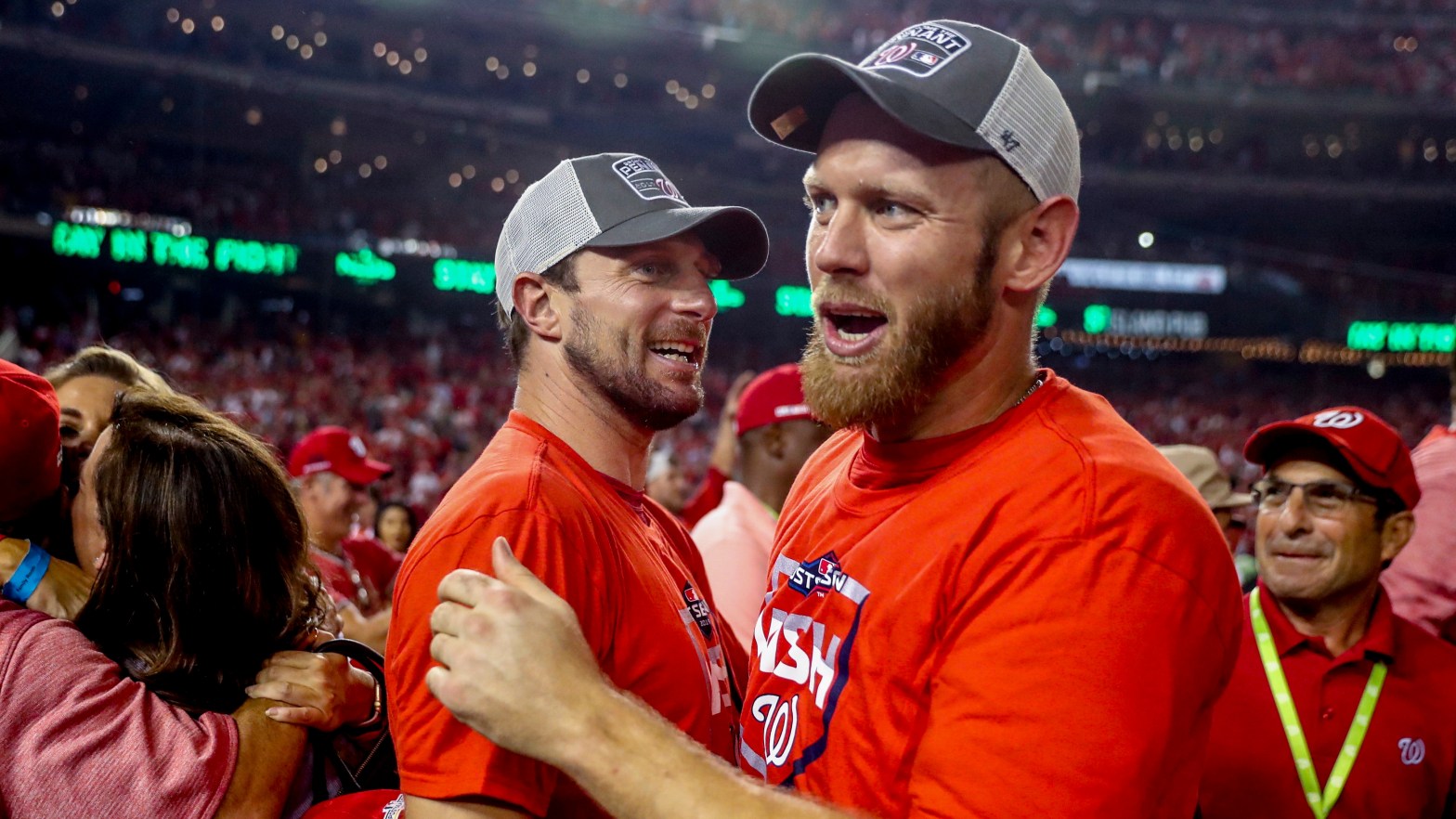
Juan Soto will always be labeled the hero for his go-ahead bloop single in the bottom of the eighth inning, and rightfully so, but it was Strasburg who came in to keep the Nats in the game after Scherzer let up three early runs.

Stras allowed just two hits over three innings in relief, striking out four batters. Now, the Nats developed a tendency of letting up early runs before locking down and stealing the game back late throughout the title run — regardless of who was on the mound — but without Strasburg’s pitching, the run would have ended before it even started.

The Wild Card game was the first instance of that trend, and perhaps it was symbolic that Strasburg took over for a struggling Scherzer to save the game, almost a passing of the torch.

October 30: Strasburg earns World Series MVP in all-time great postseason performance

While he did not pitch in the World Series-clinching Game 7, he did receive his World Series MVP trophy to cap off an all-time great postseason performance. He finished the postseason 5-0 with a 1.98 ERA and 47 strikeouts across 36.1 innings pitched (11.717 K’s per nine innings pitched) while holding opposing batters to a .239 OBP.

Two of those five wins came against eventual 2019 AL Cy Young winner Justin Verlander of the Houston Astros, the second of which saw Stras pitch the lights out in a career-defining performance to force Game 7.

The Nats would not have won the World Series without Strasburg. They also would not have won without Scherzer. Thankfully both will be back in 2020, but it seems Strasburg has shown he is more than ready to be the ace of this team if he is called to that role.

December 9: Strasburg signs seven-year, $245 million deal with Nationals after opting out of current contract following World Series

Stras agreed to the then-record deal for a pitcher — shortly eclipsed by World Series opponent Gerrit Cole — to lock him up as a “National for life,” as he put it himself. He was drafted first overall in 2009 to begin a new era in DC, and 10 years later he helped bring the team its first championship. Now, he is in a position to play in Washington for his entire career, and possibly one day become the Nats’ first homegrown Hall of Famer.

Scherzer will turn 36 in July, so it is all but certain that he will be gone before Strasburg’s contract is up, meaning Strasburg will have to step up to the No. 1 spot eventually. Plus, Scherzer dealt with health issues that lingered through the postseason, even preventing him from starting Game 5 of the World Series. He should be 100 percent for Opening Day, but who knows if he will be as reliable as before.

Strasburg has a much longer track record for health concerns, but at 31 years old, coming off a season in which he pitched over 200 innings for just the second time in his career, he has proven he is capable of staying healthy.

Scherzer is still great, and deserves to be at the top of the rotation. I am not saying a swap should be made just yet. The truth is that as Scherzer ages, as much of a monster as he is, he will eventually begin to decline.

Strasburg has never excelled in the ace role, but it has also been awhile since he had that spot to begin with. He has already delivered in the highest pressure moments, so any concerns with how he’ll fare may be unjustified. This may not be a pressing issue right now, but if Scherzer begins to fall off, or Stras carries his dominance over from October, it could lead to a new No. 1.

(Cover Photo Credit: Andrew Harnik/AP Photo)
A Tale of Two Goalies

By: Joe Pohoryles

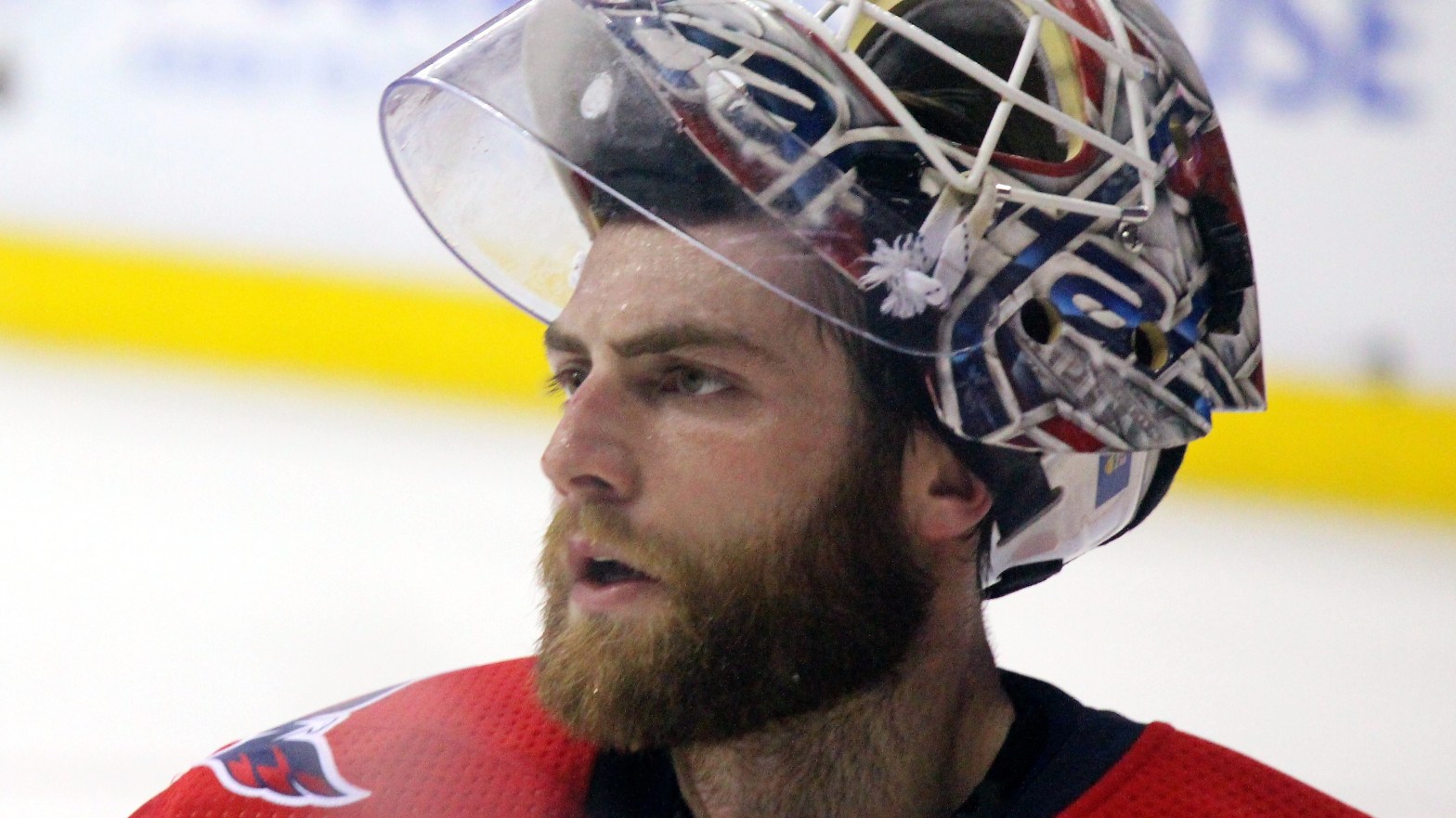
NHL All-Star weekend is upon us, and for the fifth consecutive year, the Capitals will be sending goaltender Braden Holtby as one of the team’s representatives for the Metropolitan Division. Holtby has struggled recently, so hopefully the week off and the stress-free environment of the weekend’s festivities will help bring his mojo back.

The emergence of Calder Trophy candidate Ilya Samsonov in the goalie tandem has some fans calling for the rookie to take on more starts. While Samsonov has certainly earned more playing time, Holtby should not be cast off to the side, or traded at the deadline. I’ve broken down those situations in a separate post, so today I’m going to evaluate the history of the two netminders as we head into the second half of the season.

Oh, but this does not involve Samsonov. The two goalies in question are pre-All-Star Game Braden Holtby and post-All-Star Game Braden Holtby.

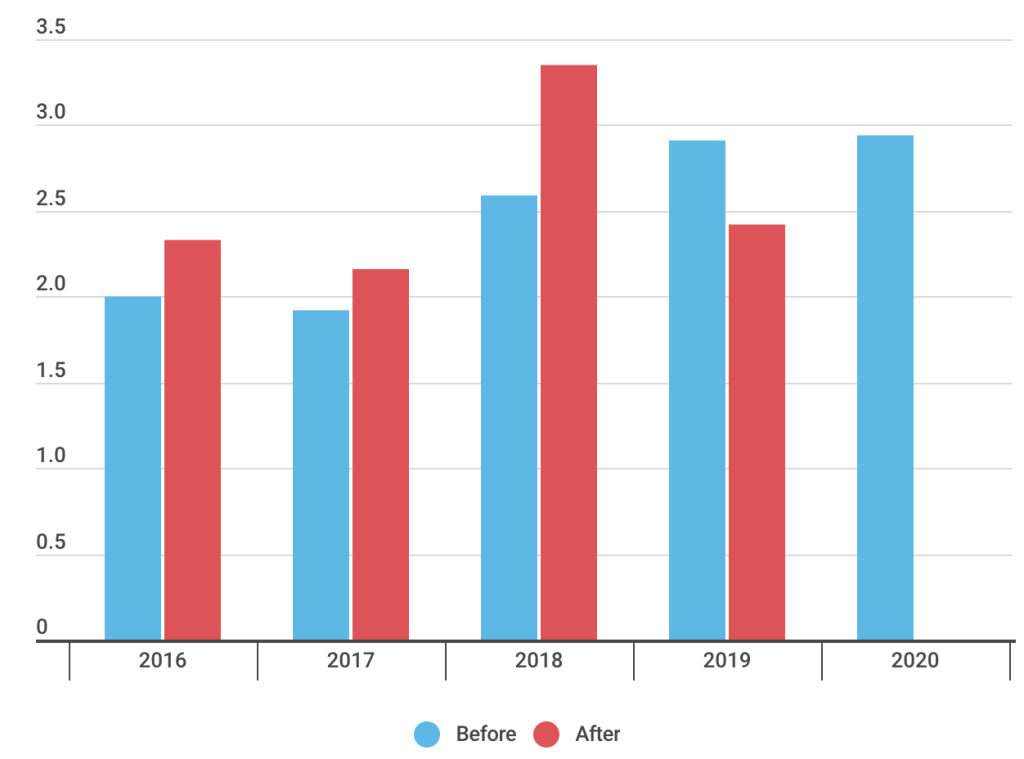
Holtby’s GAA Before & After the All-Star Game

Data collected from Hockey Reference. Infographic by Joe Pohoryles.

The All-Star Game itself likely has no affect on Holtby’s play. Perhaps the trends in his play before and after the break are mere coincidence, but it’s still interesting to look at. All-Star Weekend is not an exact halfway point, so the statistics after the break are from a smaller sample size, but both sides are large enough that the differences have significance.

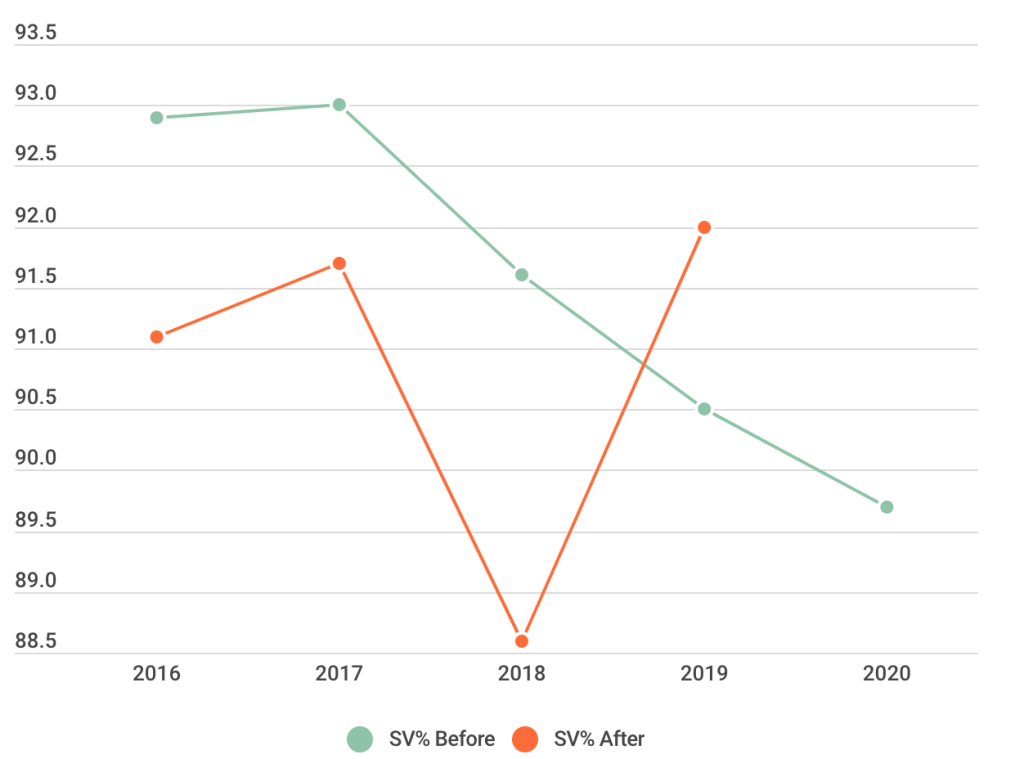
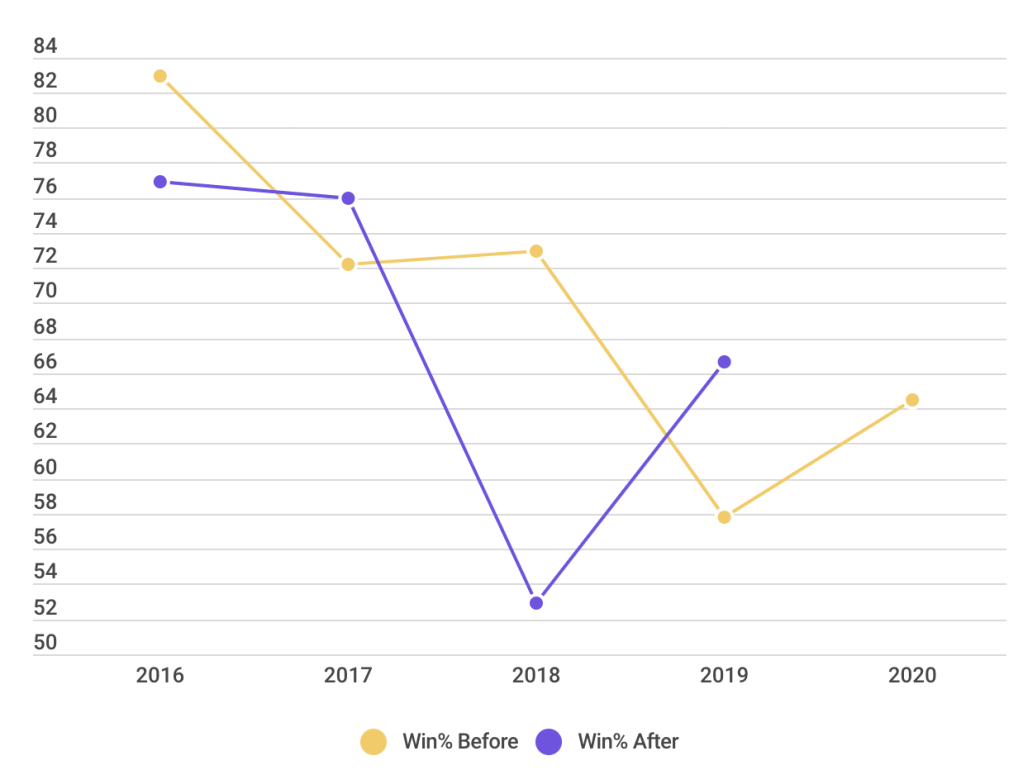
Looking at three major goaltender statistics — Goals Against Average (GAA), Save Percentage (SV%) and Win Percentage — after his first three All-Star Games, his numbers got worse for the rest of the season. This was especially the case in 2018, where his GAA swelled up to 3.35, his save percentage sunk below .900 for the first time during any pre- or post-ASG stretch in his career (.886), and his win percentage plummeted to just above .500.

As a result, Holtby lost his starting job to Philipp Grubauer by the time the playoffs came around, and we know how the rest of the story goes. Ironically enough, his worst All-Star Weekend splits came during the Stanley Cup season.

Holtby’s Save Percentage Before & After the All-Star Game

Data collected from Hockey Reference. Infographic by Joe Pohoryles.

A break in the trend came just last season, where his numbers actually improved after All-Star Weekend. That said, he also entered the 2019 edition with his worst numbers as an All-Star. Regardless, improving your numbers in the tail end of the season entering the playoffs is always a good thing.

Though Holtby enters this weekend with a better win percentage than what he had at this time last year, his GAA and save percentage are slightly worse. In the final game before the break, Holtby allowed four goals against the Islanders (primarily at the fault of the defense, which has been shaky at times this year, and shares a decent chunk of the blame for Holtby’s statistics) before Head Coach Todd Reirden subbed in Samsonov at the second intermission. The Caps scored five third period goals, thanks in part to a second consecutive Alex Ovechkin hat trick, and stole a 6-4 win. Samsonov saved all seven shots that he faced.

Ovechkin presented the team’s hard hat award — given to the player of the game as decided by the player who earned it in the previous win — to Holtby, citing his play for keeping the team in the game through two periods. It was a telling gesture. The team captain named Holtby the player of the game honors even after he got pulled. It was not out of pity; Holtby was not to blame for the initial deficit.

Holtby’s Win Percentage Before & After the All-Star Game

Data collected from Hockey Reference. Infographic by Joe Pohoryles.

What it really means is this team has their veteran, Stanley Cup-winning netminder’s back. At this point, they have seen it all, and so have we. We have now seen Holtby turn things around after the break. Even if this year falls in line with the seasons prior to 2019, and things get worse, we have still seen him come back to reach the highest peak.

It doesn’t matter what these stats say. As I said, the All-Star break’s effect on Holtby’s play could very well be entirely coincidental. What is most important is that the guys who play in front of him will stand behind him for the rest of the way.

And that could be all it takes to get Holtby back to his championship-winning ways.

(Cover Photo Credit: Wikimedia Commons)

Should the Wizards try to trade for Kevin Love?

By: Joe Pohoryles

With John Wall sidelined for the rest of the season recovering from an Achilles tear, and the Wizards sitting at 14-28, it appears this season is lost. Wall will be 30 next season, so age and the nature of his injury suggest that one of his greatest assets, speed, will be greatly diminished. His supermax contract that will pay him an average of $42,782,880 every year until 2022-23, eating up nearly 30 percent of the team’s salary cap (a percentage that should rise as his year-to-year pay increases each season), is widely considered to be the worst contract in the league today.

With Wall and Bradley Beal commanding so much cap space, the team can only fill the rest of its roster with cheap veterans and inexperienced players on rookie deals. This is not a winning formula, and with the team practically unable to unload the Wall contract to any other team, they can’t exactly blow the whole thing up and start fresh. It appears they’ll be forced to wait out these next three-and-a-half years in mediocrity or worse.

Unless they take a risk that could potentially turn this mess into a playoff team.

They already possess the worst contract in the NBA, so why not take on the second-worst one, belonging to the Cleveland Cavaliers’ Kevin Love. On paper, it sounds like a bad idea, but if it breaks the right way, it could actually make the Wizards a formidable team in the Eastern Conference.

I first came across this idea while reading a Bleacher Report article from Sept. 2019 that you can find here. I glanced at it, gave it some thought, and quickly realized this could actually be a worthwhile move. Here’s why:

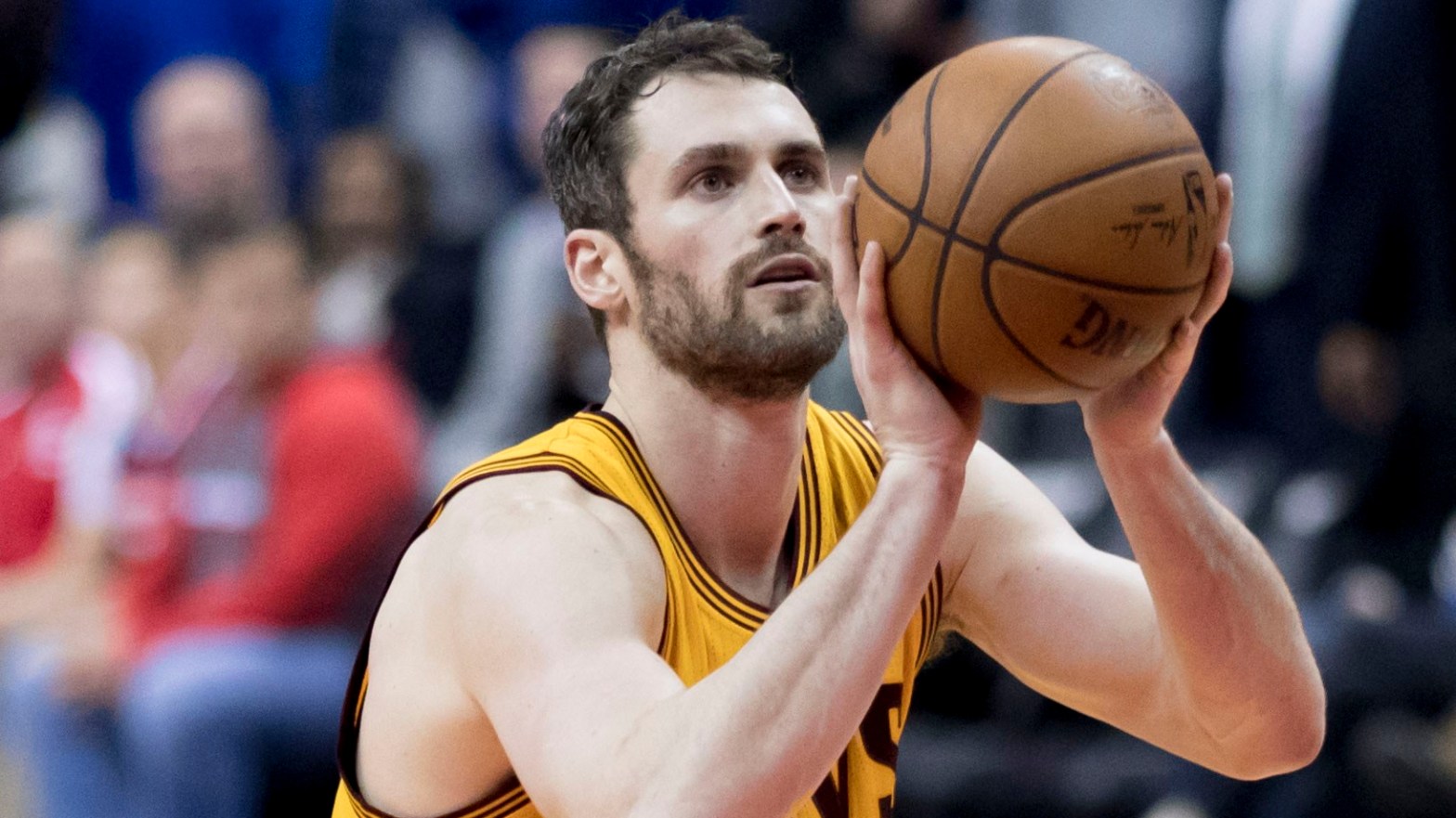
It has become very clear in recent weeks that Love wants out of Cleveland, and the Cavs would be happy to ship him out. While his efforts have been criticized recently, and his play has not helped a bottoming Cavs team, Love is a five-time All Star, his most recent appearance in 2017-18, and statistically he’s on par with his play in the past couple years.

So far in 2019-20, he’s averaged 17.3 points, 10.3 rebounds and 2.9 assists. Two seasons ago (the final year he was an All Star), he averaged 17.6 points, 9.3 rebounds and 1.7 assists. Stats don’t tell the full story, but it’s clear he could be a valuable producer for the Wizards. His attitude could improve, but it seems a change of scenery is just what he needs.

With the Cavs seemingly eager to move Love’s contract, the price for a trade should be lower than one would expect for a player of Love’s caliber. The contents of the trade would depend on whether it would go through this season or later this offseason, but the Wizards should be able to work out something reasonable.

With Wall coming back next season, and Beal under contract for another three years after this one, installing Love to lead the front court may actually be enough to make the Wizards a playoff team. Considering the less expensive contributions of Thomas Bryant and Rui Hachimura rounding out the starting five, that has potential to be a solid team in the East.

The Wizards made the playoffs in 2016-17 with Marcin Gortat and Markieff Morris in the frontcourt. Wall made Gortat a lethal pick-and-roll partner in a top 10 offense, so imagine Love, a walking double-double, in that position on offense. This all hinges on whether Wall can be an effective player upon his return, but it’s something that’s worth a try.

I’d consider Bryant to be an upgrade over Gortat at center, Love an upgrade over Morris at power forward, and Hachimura on par with Otto Porter Jr. at small forward, with potential to be better. The Wizards were the fourth seed in 2017’s playoffs without a strong bench. This improved starting five could at least match that spot in a more competitive East in 2020-21, and at the very least squeak into the playoffs. Factor in the 2020 draftee that should be a lottery pick, plus other inexpensive young guys that have shown promise like Troy Brown Jr., Mo Wagner and Admiral Schofield, and you’ve got a solid group of players coming off the bench.

Throwing that much money towards an aging power forward like Love, who will be 32 next season, is risky, but what else do the Wizards have to lose? There’s almost zero way of getting out of Wall’s contract, so instead of waste the next three seasons accepting under-.500 records, why not make a move to try and make some noise?

If they can start stringing together some winning seasons, great. They may not be championship contenders, but at least they’d be putting a quality product on the court for the fans, perhaps lucking out on a close run, building a winning culture.

Love has championship experience as the third-best player on the team, so while it’s unlikely the Wizards would be Finals contenders, if they somehow get in that position, he can be a leader who knows what it takes. That would be extremely valuable for the young guys on the roster.

However, what if Love is not impactful as hoped, Wall cannot come close to what he once was, and Beal becomes so sick of losing he eventually demands a trade? That would suck, but at least the team tried to build something. The Wizards are not generating wins as is; the worst case scenario is they just keep losing.

They’d garner some lottery picks over the next few years, and by 2023 around $73 million in annual salary will come off the books from Wall and Love alone. If Beal is still on the team, that adds another $27 million or so that will be freed up. The team will be able to start fresh with what would presumably be several lottery picks and a lot of cap space.

It would take some maneuvering to fit in Love’s contract, but based on where the team is now, I would view this trade as a low-risk, high-reward move that will either elevate the team to relevancy, or establish themselves as losers for the next few years before reaching a complete rebuild.

Note: In the future, I’ll break down the salary cap and trade logistics that would make this move possible, so make sure to check it out when that comes.

Proposal for changing the ‘Redskins’ team name

By: Joe Pohoryles

Hail to the Redskins.

For nearly 90 years, football fans in Washington have echoed the fight song celebrating the Washington Redskins’ triumphs. It is still played at FedEx Field after every touchdown. The Redskins’ fan culture was so prominent in the glory days of the 1980s that high schools across the country began adopting the Redskins name for their sports teams.

Redskins, Indians, and other (often derogatory) names for Native American people have been used as mascots at all levels of play, and was among the more popular team names nationally. Since 2013, however, the number of high schools using the name ‘Redskins’ has dropped 20 percent, according to a 2018 AP News study.

Every year, more high schools abandon these names, as the controversy surrounding them has increased. Over 115 organizations and Native American tribes have spoken out against the Washington Redskins’ name, calling for a change, according to a 2010 report by the American Psychological Association. Hundreds of other local movements around the country have led to other teams to change their name.

After a 2016 Washington Post poll found nine out of 10 Native Americans were not offended by the Redskins’ name, despite all the movements to change it, it became abundantly clear that many Native Americans embraced the team name, many were offended by it, and many others were indifferent.

Redskins’ owner Dan Snyder has claimed he will never change the name, and that the name is not meant to offend, but rather it “really means honor, respect,” as he told ESPN in a 2014 interview.

For awhile, I did not want the name to change because of the franchise’s history, and what the name meant in NFL lore. Now, looking back at the past 20 years, the state of the franchise is arguably more offensive than the team name itself. I don’t blame Native Americans for not wanting to be associated with what has been among the biggest embarrassments in professional sports.

All jokes aside, I agree a group of people should not be used as a mascot, especially under a derogatory name. A name change would not erase the franchise’s history. Look across town at our NBA team. The Washington Bullets changed to the Washington Wizards to be more sensitive to the increase in gun violence in DC. Yet the best memories of those Bullets are remembered fondly by today’s Wizards fans. The only thing that changed was the team name.

It seems like the Redskins’ name will never change, but if Snyder ever changes his mind and begins fielding suggestions, I will make my proposal here.

The Washington Red Storm

This is not my pitch for the logo; this is merely a mock-up to get “the Washington Red Storm,” idea across. (A prototype, if you will.) I strongly endorse a team of professionals to design something better than this.

I gotta give St. John’s University (NY) credit here, as it’s their team name that inspired me. The school was under similar controversy to the Redskins, as they used to be the St. John’s Redmen. While the name officially referenced the colors of their jerseys, the school did have a mascot designed to look like a Native American in the 1960s, and the name eventually changed to Red Storm in the 1990s to be more sensitive to Native Americans.

Another alternative that has been brought up for the Redskins is the name ‘Warriors.’ I’m not opposed to it, it’s a fine name. It certainly does a better job of putting Native Americans in an honorable light, and is generic enough to disassociate from Native Americans as a mascot entirely, should they ever go that route (and in my opinion, they should). My only issue with it is it would require changing more than just the team name.

There are two major parts of the team’s culture that would have to change if the team became the Warriors. The fight song “Hail to the Redskins,” would have to change. Maybe I’m nit-picky, but “Hail to the Warriors,” just does not have the same ring to it. The syllables are different, and even if you pronounce it as “War-yurs,” it sounds awkward, and just wrong. The abbreviation HTTR would also have to change. Whether it’s used in a hashtag or spoken aloud, those four letters mean a lot to Redskins fans. But HTTW? Come on people, what are we doing?

Neither of these issues exist with ‘Red Storm’ as the name, at least not to the same degree. To me, “Hail to the Red Storm,” fits much better into the fight song. The first syllable remains ‘Red-‘ and the second syllable starts with an ‘s.’ That’s about as close as you can get. Maybe the other lyrics would need to be tinkered slightly, (braves on the warpath becomes braves on the storm path? I don’t know, just spitballing), but honestly, the rest of the lyrics don’t matter as much. They could be left as is, and I don’t think anyone would really care. The main thing is keeping the “Hail to the Redskins,” part as similar as possible, and I believe ‘Red Storm’ does the best job for that.

HTTR would also apply to the team just the same. ‘Red Storm’ may be two words, but it doesn’t have to change to HTTRS, HTTR gets the same message across. Unlike ‘Warriors,’ the Red Storm would allow the rally cry to survive.

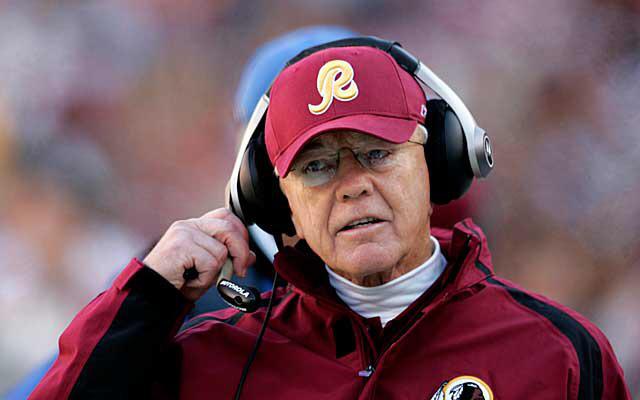
Joe Gibbs was the head coach for all three of the franchise’s Super Bowl-winning teams, and he is among the best coaches of all-time. Bringing back the golden ‘R’ Gibbs would always wear on his hat is just one way the team could maintain history and tradition without clinging onto the name ‘Redskins.’ (Photo Credit: reddit.com).

With a name like the Red Storm, the color scheme can remain the same. Changing the name is one thing, completely altering the team colors would be a much more drastic change. Burgundy and Gold fits well, as the gold represents the lightning and the burgundy could represent the clouds, which would presumably be red in a “Red Storm.” Either way, keeping the colors the same is crucial to making the change less jarring, and the Red Storm name fits the existing colors well.

The Red Storm is not a common mascot, but there are definitely more obscure names out there. (Two major American sports franchises are named after years. Specific years! Not one, two!) Weather-related team names are not unprecedented, either. The NBA has the Oklahoma City Thunder, the WNBA has the Seattle Storm and the NHL has the Tampa Bay Lightning and the Carolina Hurricanes. In the NCAA, the University of Miami (FL) teams are also the Hurricanes, so the college/professional name-sharing isn’t unheard of either.

The current logo depicting the Native American would no longer apply to the ‘Red Storm,’ so the team would have to go about finding a new logo, which could be much easier than it seems. They could re-use their previous ‘R’ logo that legendary coach Joe Gibbs would always wear on his hat.

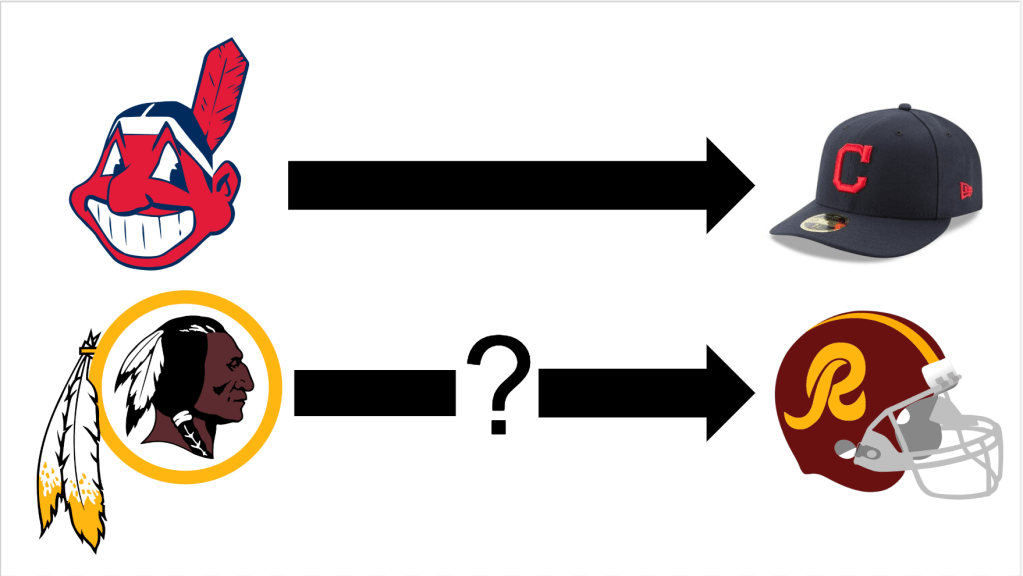
The Cleveland Indians just recently stopped using their infamous “Chief Wahoo” logo and have started using their ‘C’ logo exclusively. While Chief Wahoo was a more offensive, caricatured depiction of a Native American than the Redskins’ logo, and desperately needed to be removed, the Redskins could still opt to go the same route with their logo and re-adopt the golden ‘R.’

In 2018, Major League Baseball and Cleveland Indians’ owner Paul Dolan announced that Chief Wahoo would no longer appear on Indians’ gear, shifting exclusively to the red ‘C.’ Could the Redskins follow suit in a name/logo change?

Or they could design something completely new and different. Perhaps it could consist of actual storm clouds, or burgundy and gold lightning bolts, similar to the mock-up I made. Getting a team of professionals to design a great-looking logo should be the start. Perhaps they could release some designs to the public and have fans vote on the best one. Allowing fans to choose the logo would certainly make the transition less contentious, giving the fans a voice in the process. The options are endless.

Looking from the ownership’s perspective, a new logo would mean a whole bunch of new-look merchandise that die-hard fans would want to purchase to update their wardrobe, which would mean a decent influx in revenue. If we have learned anything about Snyder in his 20+ years as owner, that may be the biggest selling point for him.

This whole argument may be moot. As long as Snyder is in charge, I have little faith anything about the team will change, but if the franchise ever decides to leave its controversial name behind, I believe they should re-emerge and create a new legacy as the Washington Red Storm.

It’s a better name than DC’s XFL team, anyway.

Washington’s XFL franchise is named the “DC Defenders.” The XFL is set to launch in February. (Photo Credit: Washington Post)

DC United making moves after major roster turnover

By: Joe Pohoryles

English soccer legend Wayne Rooney brought a new wave of excitement to the DC United fanbase upon agreeing to a three-and-a-half-year deal with the club sitting toward the bottom of the Eastern Conference back in July 2018.

His skill, pedigree and hard work reinvigorated the team, and he was the driving force behind a slow ascent into a playoff position. The team was knocked out in the first round of the 2018 playoffs by the Columbus Crew in penalty kicks, but optimism was high for 2019 at the newly-opened Audi Field.

Rooney and breakout star Luciano Acosta formed a lethal pair, and both were named to the 2018 MLS Best XI, recognizing the best players in the league. With these two leading the charge, DC seemed capable of winning their fifth MLS Cup, their first since 2004. They started 2019 off strong by taking down the reigning-champion Atlanta United 2-0 in the season-opener, and quickly rose to first place in the Eastern Conference.

Then it all fell apart.

Before the season, Luciano Acosta’s transfer to French superpower Paris Saint-Germain fell through at the last second, even after Acosta completed his physical. The fallout impacted his morale, and his form declined with it. He was not the same player in 2019.

Then the other dominoes began to fall. The team’s form stagnated, drawing and losing matches more often than winning.

Then on Aug. 6, 2019, Rooney announced that at the conclusion of the season, he would return to England to be the player-coach of Derby County in EFL Championship, the tier below the Premier League. With two years remaining on his contract, he left early because he and his family missed England, and he wanted to transition to a coaching career. DC’s star player had one foot out the door entering the playoffs.

Rooney and Acosta’s final game with DC United was a 5-1 extra time loss to Toronto FC in the first round of the playoffs. It was 1-1 after 90 minutes; the team allowed four goals in extra time.

It seemed like the perfect metaphor for the Rooney era. The team had a lot of hope behind it, slowly building into a contender, it appeared winning it all could be a reality. Then, out of no where, at the tail end, one thing goes wrong, then another, and another, then the whole thing falls apart. You’re just left sitting there wondering, “That’s… it? That’s how it’s ending? It seems like it’s over before it really got started.”

Rooney left the team with some great memories, like the sequence of the year to set up a last-gasp, game-winner for Acosta against Orlando City SC on Aug. 12, 2018. Take a moment to click the link and watch… yeah, even if you don’t watch soccer, that’s awesome stuff. He was not just here to collect a paycheck.

But now that is all in the past, and the team is making moves to start a new era.

The club recently signed Edison Flores from Liga MX to fill the Designated Player spot. The Peruvian international represented his country in the 2018 World Cup and the 2019 Copa America, in which Peru made the finals. The 25-year-old midfielder had 12 goals and six assists across the past two seasons for his club, Morelia, and instantly becomes a top three player for the club, if not the best.

He will have to help make up for what the team is losing in Rooney and Acosta. Such an important move signifies DC is trying the Atlanta United model: build the team through less expensive, under-the-radar South American talents in the peak of their prime, as opposed to the traditional format of signing aging, world-renowned stars to monster contracts and relying solely on them.

After Rooney’s departure, the club was linked to the likes of Mesut Özil, Daniel Sturridge and Luka Modrić, all European stars, all extremely expensive, all on (or near) a decline.

Sturridge would actually make the most sense. At 30, he’s the youngest of the three, though he should be the cheapest, and the team is in need of offensive production, something Sturridge should provide as a striker. Once a starter on Premier League power Liverpool, injuries derailed his career, and at the tail-end of his stint with Liverpool, he got into a bit of legal trouble.

He’s now playing for Turkish side, Trabzonspor, and has four goals and four assist in nine league appearances. That type of production should translate to MLS play, but with Flores now holding the DP spot, it seems unlikely that signing any of those three players will occur.

That may be for the best. Atlanta won the 2018 MLS Cup employing their strategy and remain a league power. Perhaps if DC strikes gold in Flores and continues to find solid players, DC can join them.

For now, they’ll just have to wait and see.

(Cover Photo Credit: Sports Illustrated (si.com))

Re-evaluating the hot corner in 2020

By: Joe Pohoryles

Yesterday, the Nats lost out on their top free agent target. Third baseman Josh Donaldson agreed to a four-year, $92 million deal with the Minnesota Twins, officially ending the hopes of getting a high-end replacement for Anthony Rendon as the Nats’ third baseman.

A couple weeks ago, I made a series of posts evaluating the ways in which the Nats could replace Rendon. To summarize briefly, it came down to signing Donaldson, trading for one of the stars on the trade block (Kris Bryant, Nolan Arenado, etc.) or finding an in-house option/cheap free agent.

It appears the Nats have opted to go with the latter, which became apparent after they signed several veteran infielders – each one leaving less space to sign Donaldson for what he demanded – and became official last night.

It’s not a total loss, though. The division-rival Atlanta Braves were the incumbent team in the Donaldson race, so if he could not end up with the Nats, it’s a win that he’s no longer in the division (or even the National League).

In between my posts and the Donaldson deal, the Nats made a handful of moves, especially in the infield.

The first deal came on Jan. 7, when they signed Starlin Castro to a two-year deal. Primarily a second baseman, Castro also spent time at shortstop and third with the bottom-feeding Miami Marlins. The former All-Star hit .270 with 22 home runs and 86 RBI in 2019, and had an OPS of .736.

Before the deal, it was widely expected the team’s top prospect, Carter Kieboom (MLB’s No. 20 prospect), would become the team’s starting second baseman, but now it appears Castro will be the front-runner for the role, while Kieboom should get part-time duties around the infield, and serve as insurance in case of an injury.

A day after the Castro deal, the Nats brought back Asdrúbal Cabrera on a one-year deal. The 34-year-old played a big role in the Nats’ World Series run, primarily playing at second. He played 98 games at third with the Texas Rangers before being waived last season, eventually landing in Washington.

On the same day, Jan. 8, the team landed a deal with power-hitting first baseman Eric Thames. Though unlikely to spend time at third, Thames should still provide a valuable left-handed bat off the bench, while also rotating in at first with Howie Kendrick, and possibly Ryan Zimmerman if he ever re-signs. He has also spent time in the outfield, proving to be a versatile plug-in.

Along with the infield moves, the Nats also spent a decent amount of payroll tightening up a notoriously leaky bullpen, not only re-signing playoff hero Daniel Hudson, but also inking a three-year deal with the pitcher who gave up the go-ahead home run to Kendrick in Game 7 of the World Series. Will Harris, despite losing Game 7, has been one of the most reliable, consistent relief pitchers in baseball for the past several years, and will look to be a strong set-up man. Combine those two with All-Star Sean Doolittle and 100-mph hurler Tanner Rainey, and this bullpen looks a lot better than it did on Opening Day 2019.

It’s all those signings that made a deal with Donaldson very unlikely to occur. With 26 players currently signed, the team sits around $15 million under the luxury tax threshold, which the Lerner family has treated as a hard salary cap over the past couple years. Donaldson’s $23 million AAV would put them well over that threshold with over a dozen spots left to fill.

The Lerners could very well decide to go over the threshold if they see fit, but there are really no options on the open market that are better than who the team already has. Plus, as one of the highest-spending teams of the past five years, I doubt the team would want to rack up any extra costs anyway.

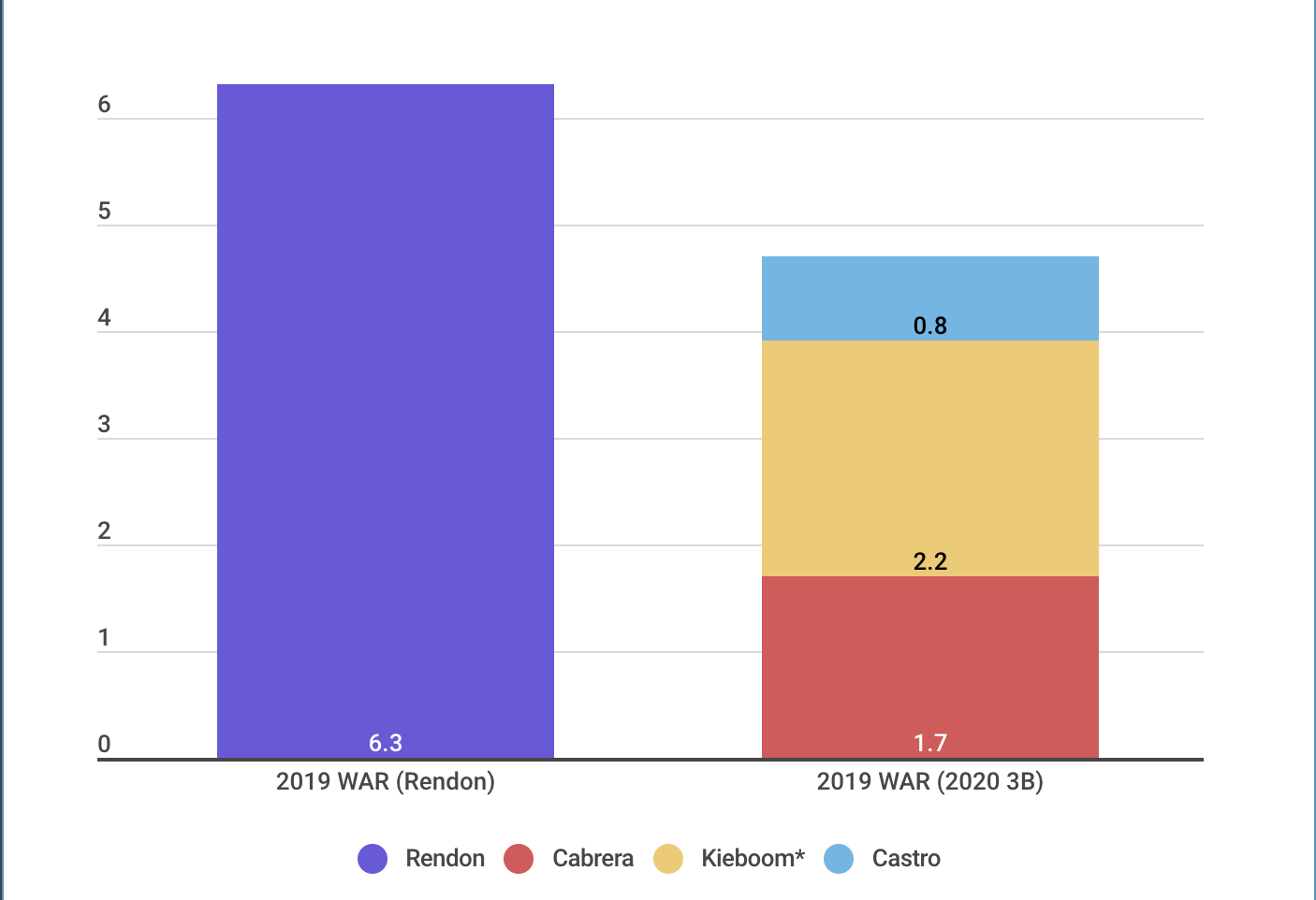
Stat comparison: Rendon vs. the 2020 third basemen

While the combined efforts of the third base candidates should drive in more runs than Rendon alone, their overall impact likely won’t come close to Rendon’s. Interesting to note, if Castro plays only at second base, and his 2020 projections are removed, then the other two players at third will fall short in HR and RBI compared to Rendon’s numbers last year. (Projections by Baseball-Reference, *Kieboom’s WAR projection for 2020 by MiLB.com; Infographics by Joe Pohoryles).

So now, it appears the team will be without an every day starting third baseman for the first time in, well, ever. Since the team arrived in DC from Montreal, Zimmerman, then Rendon have had the hot corner nailed down. The team will platoon at third for the first time. Unless a trade is still on the table.

With Castro presumably at second, it appears Kieboom is a bit more expendable. Could he be packaged in a deal for Bryant or Arenado? After all, his natural position is shortstop, which Trea Turner has to himself, and he won’t be the every day guy at second base either.

It appears unlikely, as Bryant talks have centered around center fielder Victor Robles, who has been (and should be) a no-go. Arenado has been linked to the St. Louis Cardinals, and even the Chicago Cubs, but not with Washington. Plus, it could be best for Kieboom’s development if he starts by coming off the bench, instead of being thrown into a starting role immediately. Despite his limited experience at third base, he could even contribute in that position, according to GM/president of baseball operations Mike Rizzo, and Kieboom himself.

Rizzo has given manager Dave Martinez plenty of options to work with, and after some experimenting, it appears the best combination for the infield will surface naturally. Whether that’s good enough to repeat their run from last year remains to be seen. Despite losing Donaldson, the Braves still boast a potent roster, and are the reigning-division champions with one of the best farm systems in baseball. The New York Mets made several big signings, and look poised to take a leap in 2020. (Although the Mets are the Mets, so they’re their own worst enemy.)

No one will be able to replicate Rendon’s offense, so hopefully the drop-off there can be compensated by better defense courtesy of the upgraded bullpen. Defensive ability remains a concern for those in the mix for third, but hopefully it won’t be enough of a liability to be a major issue. It will be tough to predict what the final infield will look like, especially if more bench pieces are brought in, but as of Jan. 15, this is what I believe the Nats’ infield should like on Opening Day:

1B – Howie Kendrick*

2B – Starlin Castro

SS – Trea Turner

3B – Asdrúbal Cabrera

*=Zim still needs to be re-signed, so he may receive the nod on Opening Day if he does indeed re-sign. Thames could conceivably get the start, as he is the youngest of the three (even at 33) and brings power, but Kendrick is the better hitter for average, and will likely start regardless.

Projected infield depth chart entering 2020:

1B – Howie Kendrick/Eric Thames/Ryan Zimmerman*

2B – Starlin Castro/Carter Kieboom/Howie Kendrick/Asdrúbal Cabrera

SS – Trea Turner/Carter Kieboom/Starlin Castro/Wilmer Difo

3B – Asdrúbal Cabrera/Carter Kieboom/Starlin Castro/Wilmer Difo

(Cover Photo Credit: MASN.com)

Nicklas Backstrom’s new contract, and what it means for the Caps’ future

By: Joe Pohoryles

Nicklas Backstrom agreed to a five-year, $46 million extension that will keep him in Washington through the 2024-25 season. The Caps’ all-time assist leader will be 37 years old by the end of the new contract, making it the last big contract of his career, and possibly his last NHL contract entirely if he decides to retire or play in Europe at the end of it.

Backstrom negotiated the deal himself, something we rarely see today, and he still got himself a nice pay raise. With a $9.2 million average annual value, Backy will have the second-biggest cap hit on the team behind Alex Ovechkin’s $9.5 million.

This contract may not age too well by the final couple years, as it’s always risky paying a 36/37-year-old that type of money, but having Backstrom at a discount-level $6.7 million cap hit for the past 10 years makes this is a “thank you” deal to compensate for his prior services as much as it is to keep him in DC with several good years left in the tank. I have absolutely no problem with that. He deserves it, and I’d hate to see him go play for another team.

As sad as it is to think, the Caps may no longer be a contending team by the final couple years of this contract, as the team’s core continues to age and will likely face some significant turnover by that point. If that’s the case, then letting a future Hall of Famer play out his contract before transitioning to a new era seems just fine.

But I’m not worried about the 2024-25 season right now. We still have this season to go through in 2020, but the free agencies of both Backstrom and goaltender Braden Holtby have long been discussions throughout this year, and looking at the types of deals each guy would command, and knowing the team is so tight against the salary cap, it appeared there was only room to re-sign one.

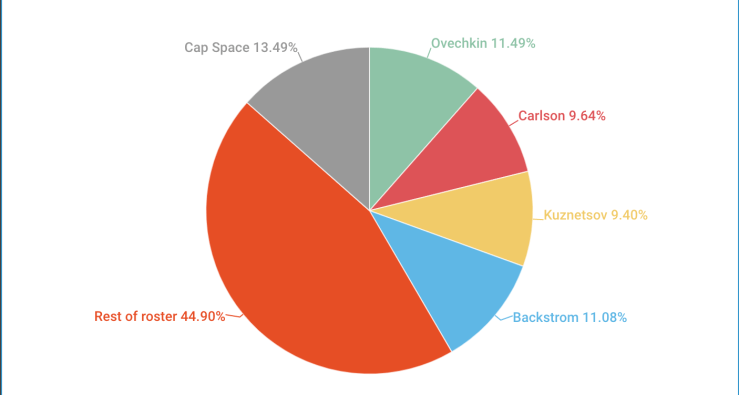
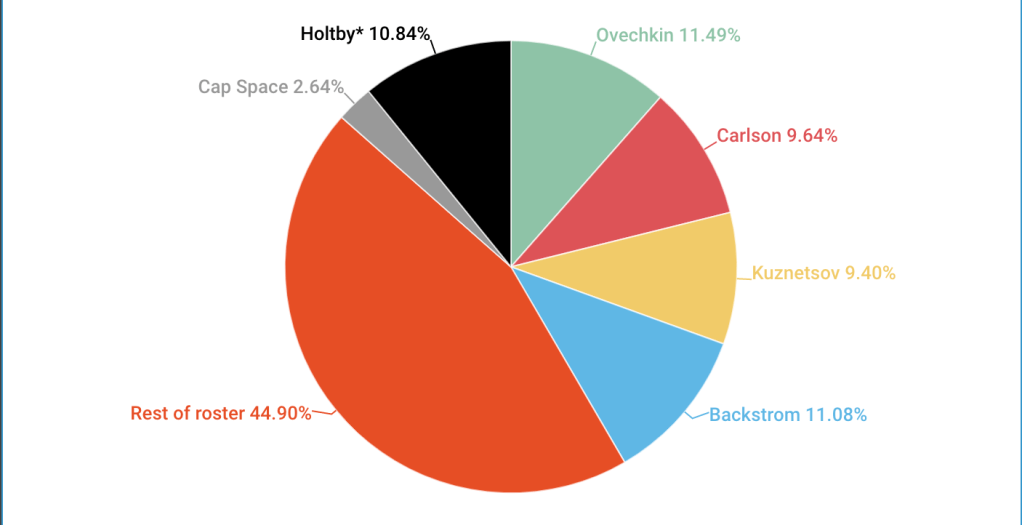
To me, this officially signals that the end of the 2019-20 season will be the end of Holtby’s era in Washington. Looking at Backstrom and Holtby alone, their respective $6.7 million and $6.1 million cap hits come off the books next season, clearing nearly $13 million in space from those two players alone. Backstrom’s new contract will eat up over $9 million, leaving $3.6 million. Radko Gudas will also be an unrestricted free agent, so his $2.3 million hit will also likely come off the books. After some other minor moves/departures, entering next season the team is set up to have just over $11 million in cap space to share across five roster spots.

Salary Cap Distribution entering 2020-21 without Holtby vs. with Holtby re-signed

Slide one shows what the salary cap distribution should look like entering next season with five spots needed to be filled. Slide two shows what the salary cap distribution would look like if Holtby re-signed with a contract that had a $9 million AAV. That would leave just over $2 million to sign four players, which averages to $500k per player. The NHL minimum salary is $700k, and will increase to $750k in 2021. (Infographic by Joe Pohoryles)

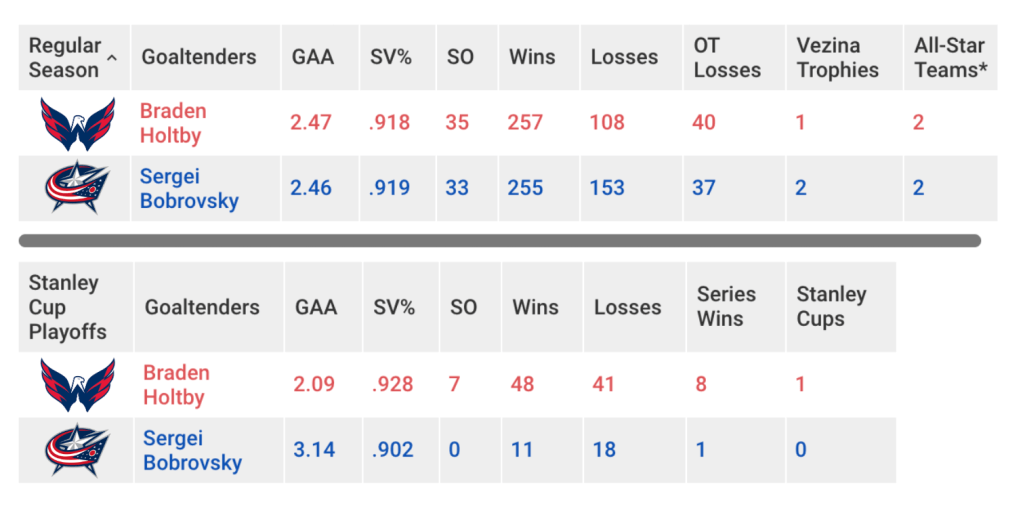
This past summer, then-Columbus Blue Jackets’ netminder Sergei Bobrovsky entered free agency and earned a seven year, $70 million deal with the Florida Panthers. Holtby will be the same age Bobrovsky was last year. The two have extraordinarily similar career regular season stats, but Holtby has a much better postseason resume. Bobrovsky has two Vezina trophies compared to Holtby’s one, but Holtby also has a Stanley Cup. Entering this season, it appeared Holtby would receive a deal as large as Bobrovsky’s, if not larger. Taking up nearly $10 million out of $11 million available for five players just is not viable, and as you can see in the charts above, they can’t even afford an $8-9 million AAV.

Now, seeing as Holtby’s play has taken a dip, and with many believing Florida overpaid Bobrovsky (although for what it’s worth, they’re in the playoff picture for the first time in several years, thanks in part to him), it seems Holtby won’t command quite as big of a contract, but he’ll certainly want to improve on his current $6.1 million AAV, which the Caps simply will not be able to afford.

Like Backstrom, this will be Holtby’s last big contract, and as much as he has said he wants to stay in DC, it appears unlikely he’ll accept a hometown discount. And you can’t blame him for it. This is his chance to earn big bucks, and he has absolutely earned that. It will be tough to see him go, and he’ll always be a Cap in my eyes, but he may not be leaving as big a hole behind in net as was expected before.

Ironic that the news of Backstrom’s signing comes the morning after Ilya Samsonov’s first NHL shutout, but that ties to one more reason why a Holtby departure seems inevitable at this point. Samsonov has been fantastic in his first NHL season, and despite the limited experience, appears likely to take over as the team’s new No. 1 netminder in 2020-21. It would be ideal to pair him with a less expensive, quality veteran to split reps with, so Sammy ends up playing somewhere around 50 games or so rather than throwing him out there for over 60 games and burning him out, but that’s a discussion for another day.

Combine the emergence of Samsonov with the impending expansion draft for the new Seattle franchise in 2021, in which the Caps would only be able to protect one goaltender, and it appears even more unlikely Holtby stays. To sign Holtby long-term would mean leaving the goalie of the future exposed, especially if Holtby demands a no-movement clause in the deal, meaning the team would be contractually obligated to protect him.

Career stats comparison: Holtby vs. Bobrovsky (2010/11 – 2018/19)

While the two star netminders have nearly-identical regular season numbers, Holtby blows Bobrovsky out of the water when it comes to the playoffs. Bobrovsky earned a seven year, $70 million deal this past summer, setting the market for Holtby this summer. *= NHL All-Star Teams named at the end of the season (like the NFL’s All-Pro), NOT NHL All Star Game appearances. (Infographic by Joe Pohoryles)

So it appears incredibly likely Holtby is gone after this season, but what does that mean for this season? Holtby is a human being, he knows everything I detailed above – the salary cap situation, the Bobrovsky deal, Samsonov’s emergence, the expansion draft, all of it – and knowing he wants to stay in DC, obviously has emotions surrounding the situation.

Holtby, being the professional he is, will not let this new development affect his play. All I know is that the elephant in the room just grew a few sizes and is now tooting a loud horn with his trunk, and you have to wonder how that will all affect the locker room, if at all.

Holtby still has his big contract to play for, so even if he had poor character and lacked class (which is not the case at all), he would have personal reasons to not quit on the team this season. It will be interesting to see how the playing time in net will be split for the remainder of the season, and how that will affect the locker room, but hopefully it will not interfere with the bigger tasks at hand.

Backstrom is here to stay, and fans should be ecstatic even if the price tag makes you feel wary. It may mean Holtby will be gone soon, but he should turn out just fine, and so will the Caps. Hopefully Backy and Holts can help lead the team to a second Stanley Cup in three years, saluting Holts and his contributions on a high note as he secures his bag elsewhere.

(Cover Photo Credit: Wikimedia Commons)

Why the College Football Playoff should not expand past four teams

By: Joe Pohoryles

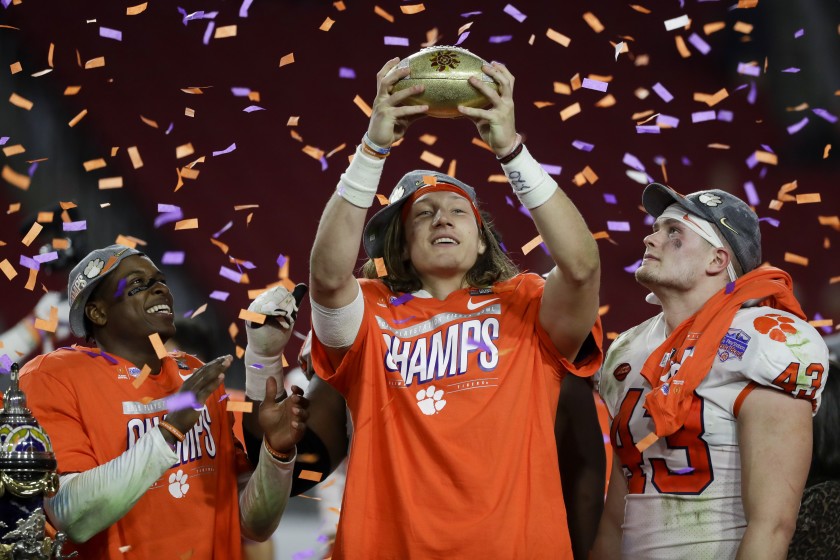
Tonight, we will see the 2019 college football season come to an end, culminating in an all-Tiger national championship game between No. 1 LSU and No. 3 Clemson. Prior to the elimination of Oklahoma and Ohio State, fans debated for weeks about which teams should make up the top four in the playoff.

They also debated whether it should even be a top four at all.

With much controversy surrounding the CFP selection committee’s decisions every year, the media, fans and even some coaches have suggested expanding the field. Fields of six, eight and 16 have all been discussed in national conversations, but the means of expansion being discussed by those actually in charge have not been publicly disclosed, at least not in detail.

While many believe expanding the playoff field would be better for the game, I believe the current format is great just the way it is, and expanding it would be worse for college football.

Why the College Football Playoff should not expand:

  • We already see lopsided semifinal games every year, expanding the field would create even less interesting games
  • It would give the end of the regular season less importance, and would remove the de facto play-in games we see in the final weeks of the regular season, as well as the conference championships.
  • It would not squash any controversy, arguments over who deserves the last spot would remain.
  • It would make the other bowl games even less relevant. Worse teams would be playing in the prestigious non-CFP bowls

The quality of teams at the top of the national rankings changes every year. This year, LSU, Ohio State and Clemson all finished undefeated. Last year, Alabama and Clemson were the two best teams by far. In the first edition of the CFP back in the 2014 season, Alabama, Oregon, Florida State and Ohio State all seemed capable of winning it all, and No. 4 Ohio State was the team that came out on top.

Ohio State may not have even made the playoffs at all that year, as No. 5 Baylor and No. 6 TCU each made convincing cases to be the last team in, though the Buckeyes clearly proved to be the right choice. The point is, every year is different, but typically there are only two or three teams that truly separate themselves from the rest, so including more good-but-not-great teams will just lessen the quality of the playoff games.

We still see blowouts in the current four-team format. Oklahoma was the No. 4 team in each of the past two seasons, and were clearly overmatched both times, despite having a Heisman-caliber quarterback at the helm (Kyler Murray won in 2018; Jalen Hurts was a distant-second in 2019). Alabama built a 31-10 lead by halftime in the 2018 semifinal, and overcame Oklahoma’s late comeback attempt, still winning comfortably by a score of 45-34. The other semifinal game that year between Clemson and Notre Dame was an even bigger blowout, as Clemson led 23-3 at halftime, before eventually winning 30-3 without either team scoring in the fourth quarter. At least Oklahoma became competitive late in the game.

This year’s Oklahoma team suffered worst of all. LSU smacked the Sooners 63-28. The game was well in-hand for the Tigers by halftime, making the second half merely a formality fans had to wait through before being rewarded with a thriller between Ohio State and Clemson. This year, Oklahoma was clearly the odd team out, so why add teams that are perceived to be worse to the mix when the “best of the rest” was clearly out-matched?

Of the 12 semifinal games that have been played since the inception of the current playoff format, nine have been won by double-digit margins, and six of those have been won by 20 points or more. If we add the supposed seventh- and eighth-ranked teams into the mix, the blowouts would become even more lopsided against the superpowers we see occupying the top spots every year. Who would want to watch match-ups even worse than the ones we already see in the semifinals?

Margins of victory in CFP semifinal games (2014-2019)

Twice as many CFP semifinal games were decided by 20+ points as there were games decided by single digits. (Infographic by Joe Pohoryles).

Of course, any team can win on any given day, and we may see an upset here and there, but more often than not, the truly great teams will be the last ones standing. That’s how it has been in recent years. The committee did not make a mistake at No. 4. This year there were just three teams significantly better than everyone else, and it showed. Georgia ended the year at No. 5, and we saw them get smoked by LSU in the SEC Championship, which leads me to my next point.

Expanding the playoff field would lessen the importance of the games at the end of the regular season. If Georgia had beaten LSU in the SEC Championship this year, it would have likely been enough for the Bulldogs to punch their ticket to the playoff, while the loss ended their hopes. Entering the match-up, the game had much higher stakes. If the playoff field was six or eight teams, Georgia would have made the playoffs despite losing, which would make the game less important from a playoff perspective.

The Big 12 Championship also had major implications. Oklahoma beat Baylor and earned the No. 4 slot. Had Baylor won, and everything else remained the same, they likely would have earned it instead. With the loss, Baylor finished as No. 7, but still would have made the playoff in an eight-team field. An expanded field would just take away the extra excitement we currently see in these games. Georgia and Baylor effectively lost their play-in games, as a Georgia victory would have locked in their place in the playoff, and a Baylor win with a Georgia loss would have vaulted the Bears to No. 4.

Not to mention, Utah was ranked No. 5 entering the PAC-12 Championship, and a win over Oregon combined with Georgia’s loss likely would have given Utah the edge. The conference championship weekend was chock full of intense “play-in” games this season.

Even games late in the regular season have playoff importance. Back in 2016, No. 2 Ohio State hosted No. 3 Michigan. Arguably the biggest rivalry in college football, match-ups between these two teams are always exciting, but the fact that the loser of that game would likely see their playoff hopes die just added extra juice to the match-up.

Ohio State edged Michigan 30-27 in double overtime, one of the best games of the year made even better because of the implications. Ohio State ended the year ranked third in the CFP rankings, making the playoffs. Michigan ended at No. 6, and likely would have made it had they won. Yet in a six or eight team field, Michigan still would have gotten in. We see examples of these de-facto play-in games every season, yet expanding the field would diminish the instances of these, if not completely eliminate them.

Nearly every season there is controversy about the teams ranked fifth and sixth that just barely miss out. People believe they deserve the fourth spot, and should not have to miss out on the playoff, which is another reason why people call for expansion. Expanding it does not eliminate that problem, and in fact arguably makes it worse the more you expand the field. If the field becomes six teams, then the arguments will just become about why the seventh or eight team deserves to be in. With eight, it’ll be about No. 9 and No. 10.

With the current format, typically the top two or three teams are markedly better than No. 4 and No. 5, while the fourth receives the edge based on a factor or two where they distinctly have the advantage over the fifth- and sixth-ranked teams. Arguments can be made, but typically they have good reason to be the final team selected. With an expanded field, that means the comparisons are made between the sixth- and seventh-ranked teams, or eighth and ninth. What makes the eighth-best team that much better than No. 9? The differences are much easier to spot near the top of the list, but the further you go down, the more the lines blur.

If anything it would cause even more controversy surrounding the final team that gets in, and it all would not matter in the end as the top three teams would likely knock them out anyway.

Number of CFP appearances by every team that has qualified since its inception

In the CFP era, just four teams (Alabama, Clemson, Oklahoma and Ohio State) have made the playoff more than once, and each of those teams, except Oklahoma, are the only teams that have ever won the championship. LSU could change that tonight with a victory over Clemson. (Infographic by Joe Pohoryles).

An expanded playoff would also lessen the quality of the other bowl games. The non-CFP New Year’s Six bowls have already lost some of its luster, but at least we still get compelling match-ups.

This year we saw No. 6 Oregon edge No. 8 Wisconsin in the Rose Bowl, 28-27. Either team would likely get blown out by the likes of LSU, Ohio State and Clemson, but their own match-up made the Rose Bowl an exciting game. No. 5 Georgia beat No. 7 Baylor more convincingly in the Sugar Bowl, 26-14, but fans still got to see a top-tier match-up despite it not taking place in the CFP.

If these teams all made the playoff, we’d have teams outside the national top 10 participating in these marquee bowl games, and while the teams would likely be evenly matched, the interest in the games would likely take a hit on the national level, as all the better teams are in the CFP. We see this effect already, but it would be even more noticeable with an expanded field.

Expanding the CFP to include more teams seems tempting on the surface, but based on the history of the semifinals, the excitement of late season games, the drop-off in talent outside the top 3-4 and the quality of other bowl games, the College Football Playoff should remain at four teams.

(Cover Photo Credit: LA Times, Rick Scuteri/Associated Press)

Making the case for which team Redskins fans should root for in the NFC playoffs

By: Joe Pohoryles

Today marks the start of the divisional round for the NFL playoffs. It’s one of the most exciting times of the year, where the best teams in the league battle it out all weekend long in their fight to this year’s Super Bowl.

With the elimination of the New England Patriots during Wild Card Weekend, there is a lot of fresh blood in this year’s playoff race, as the Kansas City Chiefs are the only team playing this weekend who made it this far last year. 

Like every year in recent memory, Redskins fans will be tuning in without a horse in the race this weekend, and what I find myself doing every year is hopping on one team’s bandwagon just to instill my own rooting interest to the playoffs, even if I only temporarily support the team.

I will never abandon the Redskins, no matter how depressing the franchise gets, but cheering for another team in the playoffs when the Skins don’t qualify always makes the games more interesting to watch. If you’re like me and looking to jump in another fanbase’s shoes for a couple weeks, here are some options:

The case for the San Francisco 49ers…

One of the worst teams in the league from a year ago has completed a major turnaround and is now a top team in the NFC, led by a former Redskins’ offensive coordinator in the NFC West division. Sounds familiar? Well that described Sean McVay’s Rams in 2018, but that story applies to Kyle Shanahan and the 49ers this year.

The Rams fell just short in the Super Bowl a year ago, but the 49ers have a chance to rewrite that part of the story themselves. The 49ers’ quarterback Jimmy Garoppolo already has two Super Bowl rings, but both came as the backup on the New England Patriots. After years of sitting behind Tom Brady, Jimmy G has a chance to build his own legacy.

For the Niners, though, it was their great defense and dominant running game that elevated them to the top of the NFC. Raheem Mostert has gone from bouncing around practice squads to leading the San Francisco rushing committee, a classic story of perseverance that’s easy to root for. 

The addition of likely-Defensive Rookie of the Year Nick Bosa in last year’s draft proved to be the finishing touch on a defense GM John Lynch has been constructing for the past few years, mainly through the draft. Three of their last four first round picks were used on defensive linemen. Another team that holds that distinction: the Redskins. Jonathan Allen, Da’Ron Payne and Montez Sweat were added in consecutive drafts, and with the expected addition of Bosa’s former teammate Chase Young this year’s draft, the Skins have taken a page out of San Francisco’s playbook.

As a Redskins fan, if you want to see the team’s blueprint to success prove its worth, a deep run by the 49ers will be an encouraging sign, so they may be the team you want to root for.

The case for the Green Bay Packers… 

Here we see yet another former Redskins’ offensive assistant at the helm in Matt LaFleur, with Green Bay back in the playoffs for the first time since the 2016-17 season. The Packers have had some questionable performances, but still wound up with a 13-3 record and a first-round bye.

Another person in the Packers’ organization with ties to the Redskins is defensive end Preston Smith, who is having a breakout season in his first year in Green Bay after four years in Washington. If you like supporting former Redskins’, the Packers could be a strong candidate.

Another reason could be seeing Aaron Rodgers win a second Super Bowl. One of the great quarterback talents of this generation has just one ring to show for it. One is better than none, but multiple championships is what helps separate the generational talents from the all-time ones. 

Rings don’t tell the full story, but at 36 years old, Rodgers only has a few seasons left to deliver, so if you want to see an aging star cement his legacy, then the Packers are your team.

The case for the Seattle Seahawks… 

Speaking of another star quarterback looking for a second Super Bowl, a deep run for the Seahawks would mean a lot more for Russell Wilson than their back-to-back Super Bowl appearances several years ago. The Legion of Boom Seahawks are no more; this is Wilson’s team.

A bigger reason to root for Seattle is linebacker Shaquem Griffin, who had his left hand amputated as a child and was the first one-handed player drafted into the NFL. One of the most inspiring stories in the league, seeing Griffin win a Super Bowl would be icing on the cake. He gets to play with his twin brother Shaquill Griffin, so that would be a major achievement for their whole family.

Seattle has the most recent success in the Super Bowl of all the teams in this year’s field, so they may not be the most obvious candidate, but the team’s “12th Man” fanbase is among the best in the league, and they certainly deserve the enjoyment of success, which isn’t to knock the other great fanbases in this year’s field, but at least it won’t be another LA Rams situation where there are fewer passionate fans to actually enjoy the run.

The case for the Minnesota Vikings… 

It seems the Redskins have ties to practically every team in the playoffs, and none is more obvious than Kirk Cousins on the Vikings. Kirk could never deliver in the big moments while in DC, and had the same trouble in Minnesota until winning his first playoff game in overtime against the New Orleans Saints last week. If you were a fan of Cousins in DC and want to see him reach the mountaintop, then the Vikings are the obvious pick. 

The Vikings also have another player with ties to the DMV, but not through the Redskins. Wide receiver Stefon Diggs is a DC-area local, dominating at Our Lady of Good Counsel High School in Olney, Md. before becoming a star player for the University of Maryland. He already has his name stamped in NFL lore from being on the receiving end of the “Minneapolis Miracle” just two seasons ago, and a Super Bowl would just add to that.

Until the Caps, Nats and Mystics all won championships in the past couple years, Washington fans were familiar with losing and disappointment (and that still exists for us with some teams). In fact, the only sports cities who were more miserable were likely Atlanta and Minneapolis-St.Paul. 

The Falcons are not in the playoffs this year, but the Vikings have a chance to bring happiness to the Twin Cities (and the entire state) that they have not experienced in nearly 30 years. If you want to see a former Redskin quarterback win it all, see a DC-area native lift the Lombardi, or support a fanbase deprived of championship joy for decades, than the Vikings are your team for these playoffs.

If you missed it, check out the AFC section here.

My personal rooting interest for the 2019-20 NFL Playoffs:

  1. Kansas City Chiefs
  2. San Francisco 49ers
  3. Tennessee Titans
  4. Minnesota Vikings
  5. Houston Texans
  6. Seattle Seahawks
  7. Baltimore Ravens
  8. Green Bay Packers

Making the case for which team Redskins fans should root for in the AFC playoffs

By: Joe Pohoryles

Tomorrow marks the start of the divisional round for the NFL playoffs. It’s one of the most exciting times of the year, where the best teams in the league battle it out all weekend long in their fight to this year’s Super Bowl.

With the elimination of the New England Patriots during Wild Card Weekend, there is a lot of fresh blood in this year’s playoff race, as the Kansas City Chiefs are the only team playing this weekend who made it this far last year. 

Like every year in recent memory, Redskins fans will be tuning in without a horse in the race this weekend, and what I find myself doing every year is hopping on one team’s bandwagon just to instill my own rooting interest to the playoffs, even if I only temporarily support the team.

I will never abandon the Redskins, no matter how depressing the franchise gets, but cheering for another team in the playoffs when the Skins don’t qualify always makes the games more interesting to watch. If you’re like me and looking to jump in another fanbase’s shoes for a couple weeks, here are some options:

The case for the Baltimore Ravens…

This one is almost too easy to make the case for for some Redskins “fans,” as many have already jumped ship to the DMV’s AFC counterpart. Nevertheless, if you’re looking for a temporary team this January, the Ravens are a fun option.

Lamar Jackson had a breakout sophomore campaign, one which will likely earn him MVP honors. He has dazzled all season long, but he still has to prove he can be successful in the postseason. The circumstances were different a year ago, but I witnessed firsthand the atrocious outing Jackson had in the postseason last year in a 23-17 loss to the Los Angeles Chargers.

Some garbage time yards and touchdowns elevated his stat line to 194 yards and two touchdowns, but he didn’t crack 100 passing yards until the fourth quarter. He also had an interception, and he fumbled the ball three times, losing it once. He was even booed off the field as fans began chanting for former Super Bowl MVP Joe Flacco to take over.

Needless to say, this year has a totally different tune to it, but if you want to root for the redemption of a budding superstar, support the most local team in the field, and believe the best regular season team should end up as champions, then you should be rooting for the purple and black this weekend. (Plus, if you ever hoped to see Robert Griffin III get a Super Bowl ring, this will be his best chance, so that’s just one other reason.)

The case for the Kansas City Chiefs…

Speaking of fun quarterbacks, Patrick Mahomes will be leading the Chiefs again after nearly taking them to the Super Bowl last year. A Dee Ford offsides penalty that overturned a game-sealing interception cost the Chiefs in the AFC Championship game last year, so fans all over Kansas City certainly feel they deserve to make it this go-around.

And if any coach in the NFL deserves a Super Bowl win, it’s the Chiefs’ Andy Reid. He had three close chances in the early-2000s with the Philadelphia Eagles, but the Lombardi has eluded Reid through his entire head coaching career.

The Andy Reid coaching tree is among the most successful in league history. John Harbaugh and Doug Pederson have won a Super Bowl, and both coached under Reid at some point. Sean McDermott of the Bills led the team to their first playoff appearance since 1999, and the Redskins’ new head coach, Ron Rivera, is a two-time Coach of the Year, and made a Super Bowl appearance with the Panthers.

Reid has made a huge impact on the landscape of the league, and based on all accounts is a great person, so if you’d like to see one of the most influential coaches in league history finally get his due, or a superstar QB not named “Lamar Jackson,” win his first ring, then the Chiefs are your team.

The case for the Houston Texans…

Ok, I’ve spoken a lot about star quarterbacks, so I’ll leave it at this: Deshaun Watson is pretty dang good. The Texans have made plenty of playoff appearances in recent years – they practically own the four o’clock slot on Saturday during Wild Card Weekend – but have never been able to make a full run. 

JJ Watt has been among the best defensive players in the league for awhile now, and the three-time Defensive Player of the Year has been through many ups and downs in his career, but never a Super Bowl. He is hampered by a pectoral injury in these playoffs, so he is not at full effectiveness, but he will still play a huge role in Houston’s run.

If you’re a fan of defensive greatness and would like to see an all-time great reach the mountaintop, then Houston is your team. Plus, I think we all remember what happened in Houston this past October. Sure, the Astros may be cheaters, but there’s no such dirt on the Texans. Perhaps DC fans owe the city of Houston a little support after what we did to them on the baseball diamond.

The case for the Tennessee Titans…

To be the best, you have to beat the best, and that’s exactly what the Titans did last weekend. Well, they did not beat this year’s best team, but they were the ones to topple the Patriots’ dynasty (or so it seems, anyway).

In order for the Titans to win, they’ll have to beat the best of 2019 as well, as they face the Baltimore Ravens, so if you prefer the underdog, then you may want to look into Tennessee.

Ryan Tannehill has found new life in Nashville after many mediocre seasons in Miami, and may earn himself a big contract this offseason, especially if he can lead his team to the promised land. Derrick Henry has also broken out in a big way. He was the league rushing champion this season, and his aggressive running style, busting through anyone in his way, is just thrilling to watch.

Mike Vrabel has done a solid job in his first head coaching gig, and has even claimed he would cut off his own penis in exchange for a Super Bowl win, so… take that as you will. If you prefer the team/coach that wants it most (or have something against Vrabel’s junk, I’m not judging), then the Titans are your team.

Edit: I have published a piece for the NFC teams, where I also listed my personal rooting preferences of this year’s playoff field from least to greatest, so if you missed it, check it out here.