
By: Joe Pohoryles
The 2021 NFL Draft is underway, and the Washington Football team will be adding their newest crop of players to fill any holes in the roster and try to improve from last year’s 7-9 record. Follow along as this post will get updated over the next few days.
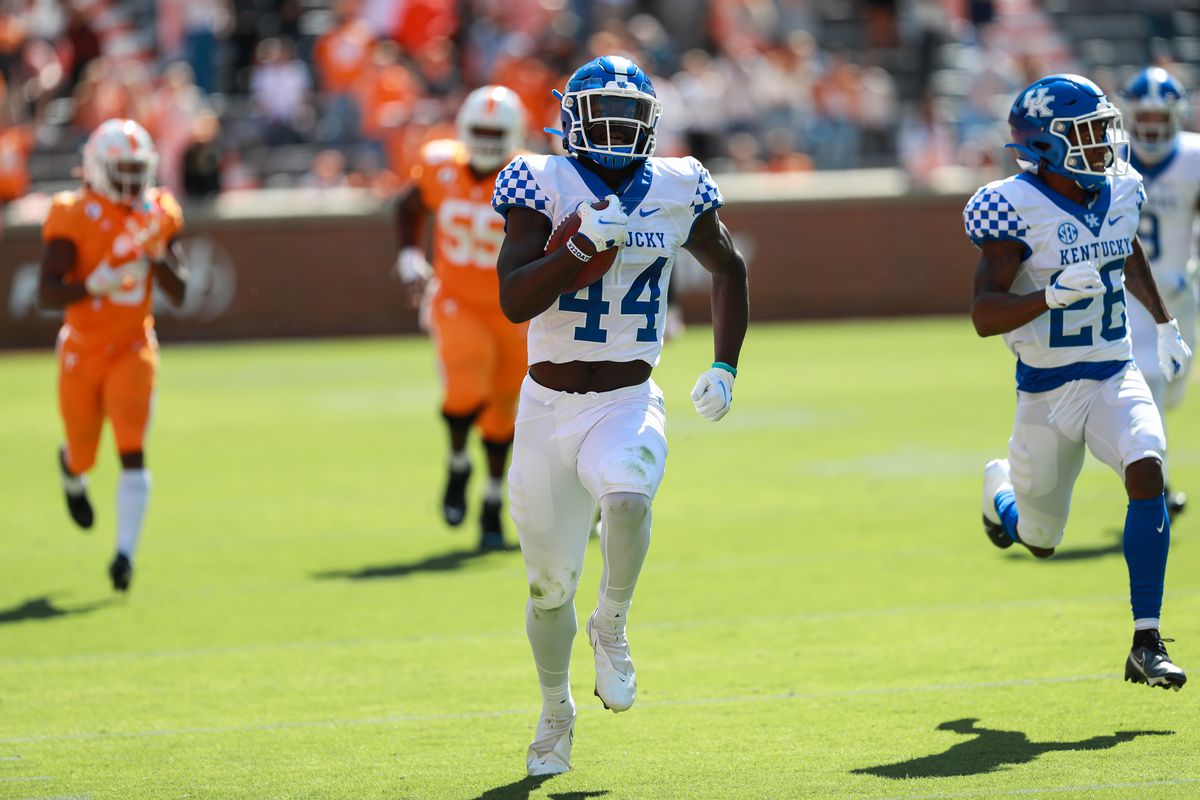
Round 1 (19)- Jamin Davis, LB, Kentucky
With five quarterbacks taken in the first 15 picks, Washington was in prime position to take a stud prospect that slipped further than they should have. Virginia Tech offensive tackle Christian Darrisaw and Notre Dame linebacker/Swiss Army Knife Jeremiah Owusu-Koramoah were among the top players in positions of need. Darrisaw could be a starter at left tackle from Day One, and Owusu-Koramoah is a weapon that could be deployed in a bevy of defensive packages.
Instead, Washington opted for linebacker Jamin Davis from Kentucky. Most mock drafts had him going in the mid-20s, with some even having him slip to the second round, but Washington felt good enough about him to take him at 19. Davis should help shore up the linebacker corps immediately, and despite starting just one season at Kentucky, he fills a major hole at inside linebacker.
Head coach Ron Rivera and general manager Martin Mayhew rated Davis as the best defensive prospect in the entire class, and while some say it was a reach, I trust Rivera and defensive coordinator Jack Del Rio (former linebackers) as well as VP of player personnel Marty Hurney (drafted Luke Kuechly) in evaluating linebackers.
Davis is an athletic freak and should do a lot of damage behind the team’s elite front four. Just look at these numbers:
After totaling just 32 tackles in 2019, Davis garnered 102 in 2020 (T-7 in FBS) as well as three interceptions. The upside is tremendous, and I even suggested Washington take Davis with their first pick in an NFL Draft segment on the show Offsides at BUTV10 (albeit, I said they should trade back):
http://www.butv10.com/shows/off-sides/#vid=540181446
(Segment is 17:30-24:00)
Even with Owusu-Koramoah still on the board, Davis looks like a great pick that plays a more traditional linebacker role than JOK. And with the Notre Dame linebacker still on the board entering Day Two, maybe he’ll slip to 51…
Probably not, but I also didn’t think he’d slip to the second round, so we’ll see what happens.
More realistic players to watch on Day Two are quarterback Davis Mills (Stanford), offensive tackles Liam Eichenberg (ND), Walker Little (Stanford) and Spencer Brown (NIU) and defensive backs Elijah Molden (Washington) and Andre Cisco (Syracuse).
Round 2 (51) – Samuel Cosmi, OT, Texas
With Morgan Moses, Brandon Scherff and Chase Roullier holding down the right side of the offensive line and the center positon, respectively, and Ereck Flowers coming back on board to pick up where he left off at left guard, the biggest question mark on the offensive line is left tackle.
Question no more: Samuel Cosmi, who many mocks had going late in the first round/early in the second, will have the opportunity to compete right away. Cornelius Lucas was quietly solid last season, and will have every opportunity to keep the starting job, but Cosmi should eventually develop into the full-time starter.
Cosmi has experience at both left and right tackle, and much like first-round pick Davis, is an athletic beast. At 6’7″ and 320 pounds, he had a RAS score of 9.99 (out of 10.00), which measures how athletic a player is. His score is the second-highest of any offensive lineman from 1987-2021.
Reports say he needs to be coached up a bit and was mismanaged at Texas, but in the proper hands, he has all the raw skill to develop into a great tackle.
Round 3 (74) – Benjamin St-Juste, DB, Minnesota
People were confused by this pick, as was I. There were other defensive backs on the board perceived to be better (including Molden, who I had listed as a possibility after Day One), but the Canadian Benjamin St-Juste was the pick.
I had not heard of him before the pick, and it seems many experts in the Washington scene had not looked at much film for him, but the corner’s 40-time (4.51) has some thinking he isn’t fast enough to play corner in the NFL, and that he may slide in at free safety, which is now the biggest hole on defense.
No matter where he’s played, this definitely seems like a risky pick with upside. We won’t know exactly where he’ll slide in, but even with the addition of William Jackson III in free agency, the secondary needed a boost, so hopefully St-Juste will provide that.
Round 3 (82) – Dyami Brown, WR, North Carolina
We’ll see what happens on Day Three, but Dyami Brown is the early favorite for biggest steal of the year (among Washington’s picks at least). Not everyone had a first-round grade on him, but snagging him at 82 is a bargain no matter how you slice it.
Once viewed as a weakness, the wide receiver corps headlines Terry McLaurin, Curtis Samuel and now Brown. Adding in Adam Humphries as a reliable slot guy, plus Logan Thomas at tight end and JD McKissic out of the backfield, I’d say it’s a strength.
Brown had over 1,000 receiving yards in each of the past two seasons. Brown should be able to line up anywhere and excels in the yards after catch (YAC) category, averaging over 20 in each of the past two seasons as well. His route running can improve, but isn’t a weakness, and if he reaches full potential, Washington may have found themselves yet another third-round steal.
Round 4 (124) – John Bates, TE, Boise State
Washington doesn’t have any tight end depth to speak of behind Thomas, so John Bates should make an impact right away. The team also signed Chilean superhuman Sammis Reyes at tight end, but he’s more of an unpredictable project.
Bates has a good frame (6’5″ and 250 pounds), which suggests his solid blocking ability should translate in the NFL, and Washington could use that. Additionally, he should generate some receptions up the middle, but won’t be a target machine, especially with all the new faces in the receiving corps.
Bates doesn’t project to be a superstar, but he has the potential to be a serviceable tight end that blocks well and can catch a few passes when you need him to, and that’s all you can ask for from a fourth-round tight end.
Round 5 (163) – Darrick Forrest, S, Cincinnati
Washington struck gold when they selected Kamren Curl on Day Three last year, and with the need at free safety, is it possible Forrest is the guy to exceed expectations this year? Probably not, but he should at least provide depth.
He has experience playing in multiple packages at Cincinnati, and should be able to challenge Troy Apke and others for playing time on special teams.
Round 6 (225) – Camaron Cheeseman, LS, Michigan
The Green Bay Packers messed up big time by not drafting Camaron Cheeseman, but I’m sure glad Washington snatched him up. Washington was in the market for a long snapper for the first time in over a decade after Nick Sundberg went unsigned this offseason.
Sundberg, who had been on the team since 2010, was the longest tenured player on the roster last season. Now Cheeseman comes in with an entirely clear path to take over long snapping duties. Among the best in the country (and yet, not even the first taken in the draft — Carolina took Alabama’s Thomas Fletcher three picks earlier), Cheeseman has the chance to become a fan favorite early on.
If he remains consistent, Cheeseman will hopefully follow in Sundberg’s footsteps and stick around for over 10 years.
Round 7 (240) – William Bradley-King, OLB/DE, Baylor
Round 7 (246) – Shaka Toney, DE, Penn State
As seventh-rounders, William Bradley-King and Shaka Toney are far from sure things, but both have potential to develop into backups for Chase Young and Montez Sweat. Both will be used situationally, and may also be able to contribute on special teams.
Toney especially seems like a prime special teams player, at least to begin his career. His 4.55 40-speed will be crucial in special teams situations, and his 5.0 sacks last year led the Nittany Lions, proving he can get after the ball carrier and finish the job. He was projected to be a mid-round pick entering the draft by some outlets, but his size (6’2″) could be part of the reason why he dropped.
Either way, with Young and Sweat in front of them, these two should have a chance to compete for a reserve spot.
Round 7 (258) – Dax Milne, WR, BYU
BYU’s Zach Wilson went second overall in this year’s draft, so it’s oddly poetic that his top receiver last year went second-to-last. Just one spot shy of being Mr. Irrelevant, Dax Milne is coming off a 70-1,188-8 season in Provo.
Even with his strong final season, Milne may not be a factor in the receiving game, and is far from a guarantee to make the roster. There are some established receivers from last year that may not make the roster this year (I’m looking at both Sims), so any impact Milne has will likely be limited to special teams if he makes the cut.
UDFA – Jaret Patterson, RB, Buffalo
Jaret Patterson’s claim to fame is his 406-yard, eight touchdown game against Kent State on Nov. 28 that tied the FBS single-game record for rushing touchdowns. The Glenn Dale, Maryland native returns to Prince George’s County where he’ll be competing with Peyton Barber, Lamar Miller and Jonathan Williams for a spot in the backfield behind Antonio Gibson and McKissic.
Patterson was also high school teammates with Young at St. Vincent Pallotti for two years before Young transferred to DeMatha Catholic as a junior.
None of Washington’s picks looked glaringly bad, and Brown, Cosmi and Toney all seem like good value picks. Quarterback wasn’t address, but multiple other needs were filled. If I had to grade the class, I’d give it a B+, but of course we won’t know how well this class performs until the season kicks off.
If this class can hit the ground running just like the 2020 class, Washington should be in very good shape to repeat as division champions, and hopefully even more.
(Cover Photo Credit: Jacob Noger/Collegiate Images/Getty Images)
 The Wildcard