
Major League Soccer has long attracted aging world-class superstars such as David Beckham, Kaká, David Villa and plenty others to spend the twilight years of their careers in the United States. Their best years are behind them, but name recognition alone makes them valuable commodities to their new clubs from a business standpoint.
Wayne Rooney, the all-time great English striker who spent one-and-a-half seasons with DC United from 2018-2020, fits that description. He also falls under the category of players who actually improved their teams dramatically. Rooney made numerous highlight reel plays and led DC United to the playoffs twice.
It’s only fitting Rooney spent some of the final years of his playing career in Washington (he just retired from playing earlier this week) because over the past 20-plus years, it seems as if the major American sports teams in the nation’s capital have taken a page out of MLS’s book, titled “The Retirement Home of World Soccer.”
MLS has been growing into a league that develops more home-grown stars, but still has not shed that label. Meanwhile, the major DC Sports teams are still bringing in aging stars past their prime left and right, the most recent example coming just three days ago.
Jon Lester, the 37-year-old left-handed pitcher fresh off a six-year stint with the Chicago Cubs, signed a one-year deal with the Nationals. Lester should slide into the fourth spot of the starting rotation still headlined by Max Scherzer, Stephen Strasburg and Patrick Corbin.
Lester is a three-time World Series champion and a five-time All-Star. He’s finished top five in Cy Young voting three times, although his best finish was second in 2016. Those days seem far behind him, as he posted a 4.46 ERA in 2019 and allowed an NL-leading 205 hits, but he was also an All-Star just a year prior in 2018.
Adding Lester on as a back end starter appears like a solid move to help improve the rotation as a whole, and it means Lester won’t be relied on to perform like the Cy Young finalist he was in the past, but it’s just another name in the long list of over-the-hill stars brought into DC on their last legs.
A little over a year ago, I wrote about the Top 10 too early/too late signings in DC Sports history, which means the best players that came to Washington either before or after they had peaked. Most of the players on that list came after, and these signings have continued to this day.
Here’s the first half of an unofficial timeline of how Washington became Washed-ington in the US Sports landscape:
1999-2001: Snyder’s Infancy
Infancy, of course, refers to the first years of Dan Snyder’s ownership of the Washington Football Team, but it doubly applies to his general temperament as an owner, which unfortunately has not been outgrown.
Snyder came in with deep pockets and little patience, aggressively signing washed up players to come to Washington. Only a handful were big stars that got a ton of money, but here are a few notable old guys brought in well-past their primes:
QB Jeff George:
- Age/Experience: 33/11th season
- Year: 2000
- Contract: Four years/$14.8 million
- Games played in Washington: 8
K Eddie Murray:
- Age/Experience: 44/19th season
- Year: 2000
- Contract: One year/$440,000*
- Games played in Washington: 6^
*= Estimated salary
^ = He played the full 1995 season with the team in a previous stint
DE Bruce Smith:
- Age/Experience: 37/16th season
- Year: 2000
- Contract: Five years/$23 million
- Games played in Washington: 62
DB Deion Sanders:
- Age/Experience: 33/12th season
- Year: 2000
- Contract: Seven years/$56 million
- Games played in Washington: 16
P Bryan Barker:
- Age/Experience: 37/12th season
- Year: 2001
- Contract: Unconfirmed
- Games played in Washington: 44
RB/WR Eric Metcalf:
- Age/Experience: 33/12th season
- Year: 2001
- Contract: Unconfirmed
- Games played in Washington: 10
Only Smith and Sanders were Hall of Famers, and Smith wasn’t all that bad given the production he brought for four seasons at his age, but they both highlighted the first signs of old stars coming to Washington. This narrative grew exponentially with the arrival of the most notable over-the-hill athlete to ever play in this city.
2001-2003: The Real Last Dance
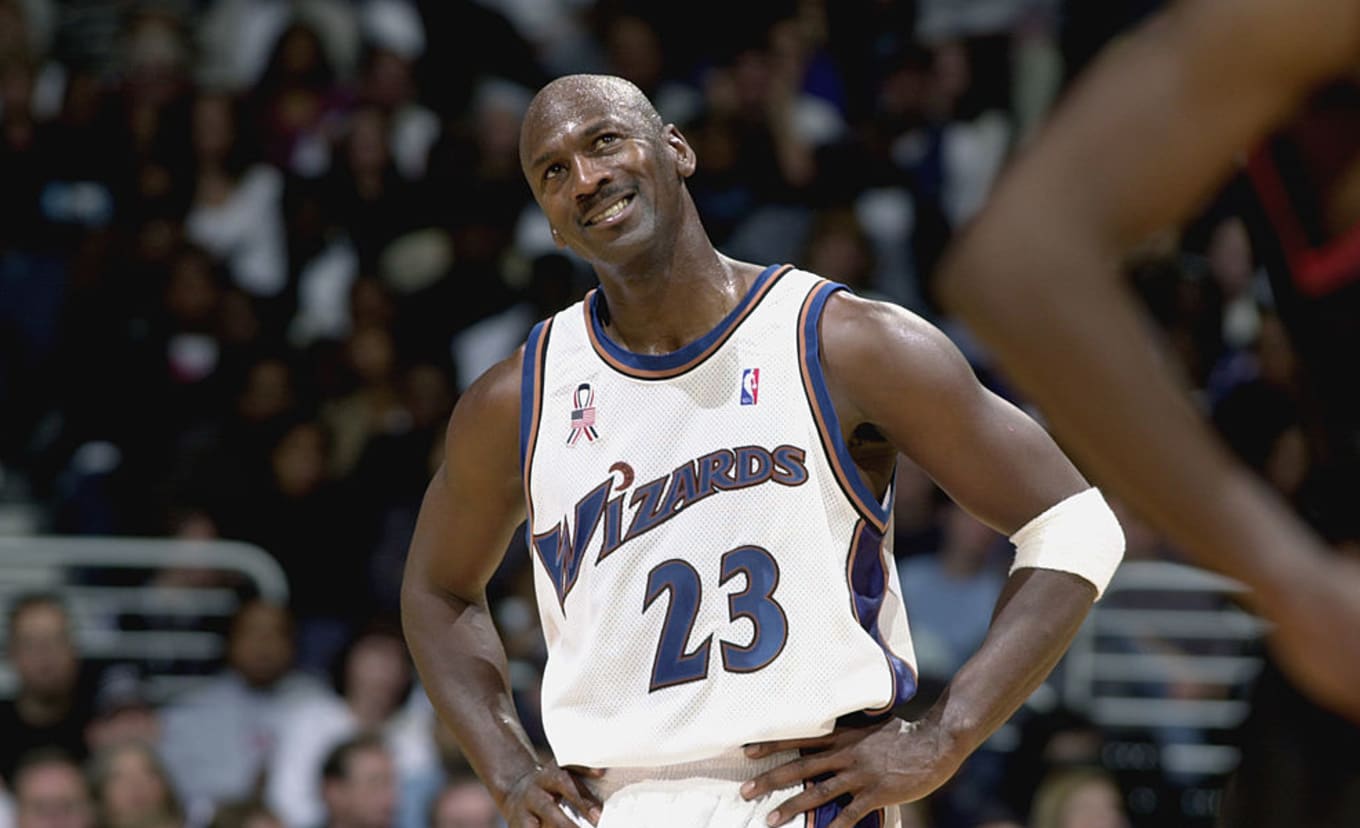
After his second retirement from the NBA, Michael Jordan became a part owner and president of basketball operations for the Wizards. This was the birth of his rocky career as an NBA executive, his most notable move coming in the 2001 NBA Draft where he selected Kwame Brown first overall.
Brown became one of the biggest busts in NBA history, but Jordan soon joined his prize draft pick as a teammate by coming out of retirement a second time. Suiting up for Washington at 38, MJ led the team in points (22.9), assists (5.2) and steals (1.4) per game and made the All-Star Game. Whether this says more about the Wizards’ lack of talent or about Jordan’s greatness can be debated, but Jordan was far less washed than other former stars to finish up in Washington.
That said, he was naturally far removed from his peak in Chicago. Jordan retired for good after two All-Star seasons with the Wizards. He was fired from the Wizards front office by owner Abe Pollin after a handful of disagreements and eventual falling out during Jordan’s tenure with the team.
2004-2006: Nats and Caps join the Retirement Party
This was a relative down period for major “old guy” signings, but as the Expos were transitioning to the Nationals and the Capitals began building around Alex Ovechkin, both teams began inking old players to fill in the gaps.
The Caps brought in 36-year-old center Andrew Cassels and 34-year-old defenseman Jamie Heward in 2005, then added 35-year-old winger Donald Brashear in 2006. None were All-Star caliber players at any point in their careers, and they weren’t ‘ancient’ in hockey terms, but it followed the trend.
The Nationals, meanwhile, brought in five players aged 35 or older for their first season in Washington.
- LHP Mike Stanton (38)
- INF Vinny Castilla (37)
- INF Carlos Baerga (36)
- C Keith Osik (36)
- RHP Hector Carrasco (35)
Stanton, Castilla and Baerga were each former All-Stars, and also happened to be the three oldest players on the ’05 Nats. Castilla was the starter at third base before Ryan Zimmerman had established his place here. None of the five players above were paid lucratively, but it reveals a lot about the conditions of the Nationals when they first started.
In 2006, the Nats added 37-year-old RHP Pedro Astacio and 1997 All-Star shortstop Royce Clayton, who at that point was 36.
As an added bonus, the Washington Football Team signed Ray Brown in 2004, who played with the team from 1989-95 in a previous stint. The offensive lineman played in all but one regular season game from 2004-2005 in his age 42 and 43 seasons.
Former All-Pro corner Troy Vincent also played part of his age 36 season with Washington in 2006 after stints with the Dolphins, Eagles and Bills.
2007-2010: The Old Guy Renaissance
In this period, a handful of significant aging player signings were made on every major DC team except for the Wizards.
Career backup quarterback Todd Collins was signed in 2006 at 35, but his most significant season came in 2007 when he replaced the injured Jason Campbell to finish the season. Collins went 3-0 in his three starts and helped lead the team to the playoffs. In four regular season appearances, Collins passed for 888 yards and five touchdowns with zero interceptions. However, he went 29/50 for 266 yards plus two touchdowns and two picks in the Wild Card loss to Seattle.
The Capitals acquired Russian legend Sergei Fedorov at the 2008 Trade Deadline, allowing Ovechkin to play with one of his idols. The Hall of Famer posted 46 points (13g, 33a) in 70 regular season games with the team, but his most notable moment came in the first round of the 2009 playoffs when he scored the game-winning goal in Game 7 against the New York Rangers.
The Nationals brought in former Yankees playoff hero Aaron Boone for the 2008 season at 35 years old, but nothing significant came from it. The bigger moves around this time was the return of Liván Hernández in 2009 and the signing of Iván Rodríguez in 2010.
Hernández was one the Nats’ first All-Stars in 2005, but he came back to the team in 2009 at 34 years old with a much smaller role. “Pudge” meanwhile played 111 games at catcher at 38 years old in 2010. He hit .266 while knocking in four home runs and 49 RBI. He played a bench role in 2011 in what would be his final MLB season.
The Washington Football Team, meanwhile, brought in a future Hall of Famer of their own in 2008. Jason Taylor, two seasons removed from winning Defensive Player of the Year honors, was traded to Washington for one second-round and one sixth-round pick after 11 seasons with Miami Dolphins.
His tenure here was so short and forgettable that I actually had no clue he even played in Washington until writing this article, despite being old enough to remember the 2008 season. The 34-year-old defensive end appeared in 13 games, making eight starts and garnering just 3.5 sacks on the season after compiling 12, 13.5 and 11 in the three seasons prior. He was released that offseason after refusing to attend practices, wishing to be closer to home, and he returned to the Dolphins for the 2009 season.
Then in 2010, 34-year-old quarterback Donovan McNabb was traded to Washington after a long career with the rival Eagles. He clashed with the coaching staff, lost the starting job after 13 games and was gone by that offseason. Joey Galloway, the then-39-year-old receiver, spent his 16th and final NFL season in Washington, accumulating just 12 receptions and 173 yards across 10 games in 2010.
That’s one future Hall of Famer on all three teams (Fedorov, Rodríguez and Taylor) spending what would only become a footnote in the story of their entire career, but it was a distinctive time nonetheless.
There is still an entire decade of Washed-ington history to go through, so make sure to check back in for Part Two.
Cover Photo Credit: Doug Pesinger/Getty Images
 The Wildcard