
After much uncertainty, the NFL has nearly completed the regular season. There were plenty of bumps along the way, but ultimately no games needed to be canceled/postponed to the end of the season. Best of all, fantasy football could be played without a hitch.
Last year, I published my ballots for the All-Fantasy Football Teams. To my knowledge, I’m the only person who makes a ballot like this, but it’s still something I enjoy doing. Traditional fantasy rankings are flawed, only taking into account total points while totally ignoring outliers performances and which players consistently put up the best numbers.
I wrote this in last year’s 2019 All-Fantasy Team post:
Since 2016, I’ve constructed my picks for All-Fantasy teams, similar to the All-Pro teams we see in the real NFL. Fantasy football is entirely based on statistics, so differentiating the good from the great is fairly easy, but I don’t stick to the simple rankings based on total points scored. It’s the players who put up consistently great numbers week to week that are truly fantasy football All Stars. Would you rather have a player who, through four games, scores 35, 5, 24, and 7, or a player who puts up 17, 21, 16, and 13?
Personally, I want a player like the latter, someone who I can consistently rely on to put up double-digit points, with potential for a big-time game rather than a player like the former who, while capable of monster performances, cannot be trusted due to several lackluster scores that can cost you an entire matchup. In this scenario, Player A scored 71 points through four weeks, while Player B put up 67. Under standard ranking systems, Player A would be ranked above Player B, but is he really the better player?
This is why I don’t trust the point-total rankings and try to look at the context. I even came up with my own adjusted points per game metric to eliminate outlier performances in an effort to determine who the best week-to-week players are. It’s a fairly simple process, and hardly advanced analytics, but I believe it’s a good indicator.
Here’s how it works:
- I count the player’s scores from Weeks 1-16. Most fantasy seasons end in Week 16, as many starters on NFL playoff teams sit out Week 17.
- Factoring in the bye week, a player who plays every game in a fantasy season will have 15 games.
- I then look for their two highest-scoring performances and two lowest-scoring performances, and throw them away.
- This adjusted point total is then averaged out among the remaining games (i.e. four games removed from a 15-game player will have their new total averaged out across 11 games. 14-game players will be averaged out across 10, and so on).
- In close cases, I also took into account who posted fewer low-scoring games/more high-scoring games as well as who performed better in the playoffs (Weeks 14-16)
- These new averages paint a picture of who truly was the best, most consistent player. It eliminates the outliers, both high and low, without compromising the sample size.
Beyond the adjusted points per game (aPPG), the number of games played is also taken into account. Cleveland’s Nick Chubb had the fourth-highest aPPG among running backs, which would normally be good enough for Second Team honors. However, while most running backs played 14-15 games, Chubb played just 11 due to injuries, which knocks him back a few spots. A major part of being the best, most consistent player is actually being available to play. With Chubb’s adjusted point total (aPT) being averaged out across just seven games, the sample size is less reliable.
Most of what goes into these rankings is pure statistics, and numbers never lie, but there still is room for subjectivity. Jacksonville’s James Robinson had 16.78 aPPG and Chicago’s David Montgomery had 16.77 aPPG. With averages that are practically identical, it comes down to which factors you prioritize more; do you rank the guy with more 20-plus point games higher or the one who had fewer single-digit point games? Do you prioritize the player who performed better in the fantasy playoffs, and was thus more likely to help you win the championship? They’re all important factors, but it comes down to personal preference in terms of which are more important.
I take it all into account, and so without further ado, here are The Wildcard’s 2020 All-Fantasy Teams, which includes the All-Bust Team, All-Breakout Team, All-Injured Team and All-Rookie Team. (Note: These rankings are based on the PPR scoring format)
First Team All-Fantasy
QB: Kyler Murray, Ari (25.15 aPPG)
RB: Alvin Kamara, NO (23.65 aPPG*)
RB: Dalvin Cook, Min (22.46 aPPG)
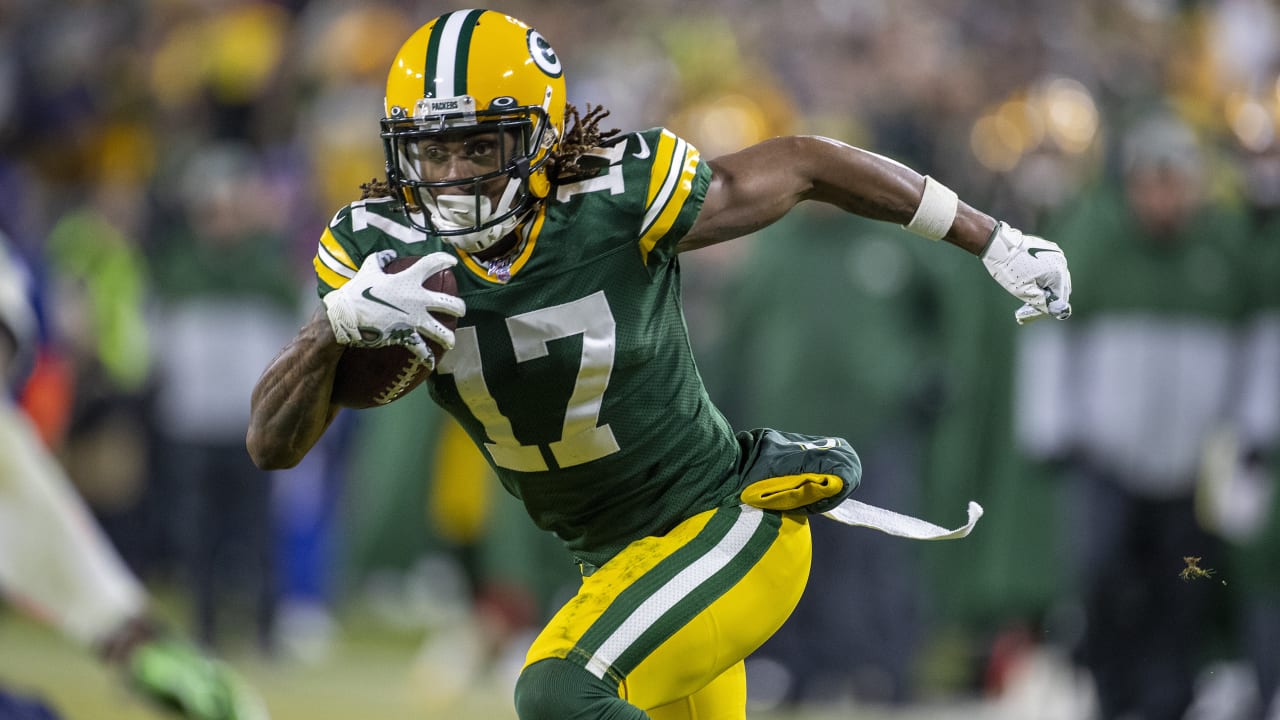
WR: Davante Adams, GB (26.24 aPPG**)
WR: Stefon Diggs, Buf (20.14 aPPG)
TE: Travis Kelce, KC (21.95 aPPG)
FLEX: Tyreek Hill, KC (20.17 aPPG)
D/ST: Steelers, Pit (9.27 aPPG)
K: Younghoe Koo, Atl (11.30 aPPG*)
Total aPPG: 180.33
(Bold = Fantasy MVP; * = 14 GP, ** = 13 GP; *** = 12 or fewer GP)
You could easily argue that Alvin Kamara or even Travis Kelce deserves Fantasy MVP honors, but the fact that Davante Adams has the highest aPPG in the entire league (even more than any quarterback), and that he tops the next-best in his position by over six points per game makes him the pick for me.
He missed two games early in the season, but that’s the only knock against him. During his touchdown streak between Weeks 7-14, he racked up 12 trips to the pay dirt, and his 11 rec – 142 yd – 3 TD stat line in Week 16 for 43.2 fantasy points was the cherry on top. He led the league in receiving touchdowns (17) and was fourth in receiving yards (1,328).
For the first time in my history of making All-Fantasy Teams, a receiver has earned MVP honors. Here is the full history of my Fantasy MVPs:
- 2016: RB David Johnson, Ari
- 2017: RB Todd Gurley II, LAR
- 2018: QB Patrick Mahomes, KC
- 2019: RB Christian McCaffrey, Car
- 2020: WR Davante Adams, GB
The reason Stefon Diggs has the edge over Tyreek Hill despite having a slightly lower aPPG is Diggs’ significantly better playoff performance. Both players had the same number of games scoring fewer than 15 points (three) as well as the same number of games scoring greater than 25 points (five), but Diggs averaged 32.1 fantasy points per game in the playoffs, while Hill averaged 18.
Second Team All-Fantasy
QB: Aaron Rodgers, GB (24.86 aPPG)
RB: Derrick Henry, Ten (18.77 aPPG)
RB: David Montgomery, Chi (16.77 aPPG*)
WR: Calvin Ridley, Atl (19.75 aPPG*)
WR: Deandre Hopkins, Ari (18.72 aPPG)
TE: Darren Waller, LV (15.25 aPPG)
FLEX: James Robinson, Jax (16.78 aPPG*)
D/ST: Rams, LA (9.18 aPPG)
K: Jason Sanders, Mia (10.73 aPPG)
Total aPPG: 150.81
Third Team All-Fantasy
QB: Josh Allen, Buf (25.05 aPPG)
RB: Nick Chubb, Cle (18.30 aPPG***)
RB: Aaron Jones, GB (16.72 aPPG**)
WR: DK Metcalf, Sea (17.21 aPPG)
WR: Keenan Allen, LAC (17.01 aPPG*)
TE: Mark Andrews, Bal (12.43 aPPG**)
FLEX: Adam Thielen, Min (16.95 aPPG*)
D/ST: Colts, Ind (8.36 aPPG)
K: Daniel Carlson, LV (9.64 aPPG)
Total aPPG: 132.03
All-Fantasy Honorable Mention
QBs:
- Patrick Mahomes, KC (24.29 aPPG)
- Deshaun Watson, Hou (22.75 aPPG)
- Russell Wilson, Sea (22.68 aPPG)
RBs:
- Jonathan Taylor, Ind (15.06 aPPG*)
- Chris Carson, Sea (16.27 aPPG***)
- Ezekiel Elliott, Dal (14.84 aPPG*)
- Antonio Gibson, Was (13.99 aPPG**)
- Kareem Hunt, Cle (13.48 aPPG)
WRs:
- Will Fuller V, Hou (17.24 aPPG***)
- Allen Robinson II, Chi (16.81 aPPG)
- AJ Brown, Ten (16.88 aPPG**)
- Justin Jefferson, Min (15.63 aPPG)
- Brandon Aiyuk, SF (16.36 aPPG***)
TEs:
- TJ Hockenson, Det (11.93 aPPG)
- Hunter Henry, LAC (10.62 aPPG*)
- Robert Tonyan, GB (10.35 aPPG)
- Logan Thomas, Was (10.26 aPPG)
D/STs:
- Dolphins, Mia (7.36 aPPG)
- Football Team, Was (7.00 aPPG)
K:
- Rodrigo Blankenship, Ind (9.55 aPPG)
It was a four-horse race at quarterback, and Patrick Mahomes was the odd man out. Besides having the lowest aPPG (by just a slight margin), Mahomes also had the lowest playoff PPG with 21.23. Here are the comparisons between the top four quarterbacks:
| Quarterbacks | aPPG | Games with <20 points | Games with 30+ points | Playoff PPG |
| Kyler Murray, Ari | 25.15 | 4 | 4 | 22.33 |
| Aaron Rodgers, GB | 24.86 | 3 | 2 | 24.79 |
| Josh Allen, Buf | 25.05 | 6 | 6 | 29.43 |
| Patrick Mahomes, KC | 24.29 | 4 | 4 | 21.23 |
The margins are slim, and you could put any quarterback at First Team QB and not be wrong… except for Mahomes. Kyler Murray is better than or the same as Mahomes in all four major categories. Murray’s elite rushing production helps him keep pace with the other three, who are real-life MVP candidates.
Josh Allen, meanwhile, has the most 30+ point performances of the group, but also the most games with fewer than 20 points. With only three games between 20-30 points, Allen had the most inconsistent, “boom-or-bust” type of season of the four, which puts him out of the running for First Team in my eyes, despite his terrific overall production and top-end fantasy playoff averages.
Conversely, Aaron Rodgers had the fewest 30+ point games, but he also had the fewest games with under 20 points and had the second-highest playoff average. With 10 games between 20-30 points, Rodgers had the most consistent year while also playing at an elite level in the playoffs. For those reasons, Rodgers gets the Second Team nod.
From there, it’s a toss-up between Allen and Mahomes, but I gave Allen the edge due to his better averages. Even if Mahomes was slightly more consistent than Allen throughout the year, Allen averaged 8.20 more points per game in the playoffs, which is a major difference in a championship push. Putting Mahomes as the Third Team or even Second Team quarterback is reasonable, but for the reasons above, I have him falling just short.
As for the other two Honorable Mention quarterbacks, Deshaun Watson and Russell Wilson, both finished with near-identical aPPG, and no other quarterback averaged more than 22 aPPG, putting the cut-off at those two for Honorable Mention.
The other biggest controversy is Third Team tight end. Kelce is the only reasonable First Team tight end, and Darren Waller is the clear Second Teamer, but the Third Team was up for grabs.
It’s a shallow position group, and while Mark Andrews missed two games and was fairly inconsistent, TJ Hockenson was not consistent either. While both players had the same amount of single-digit games (five), Andrews had three games with 20 points or more. Hockenson had zero such games. Andrews also averaged 14.67 points per game in the fantasy playoffs, while Hockenson averaged just 8.13. This choice is much easier than quarterback.
And now, here are the bonus teams:
All-Bust Team
QB: Carson Wentz, Phi
RB: Miles Sanders, Phi
RB: Clyde Edwards-Helaire, KC
WR: Michael Thomas, NO
WR: Chris Godwin, TB
TE: Zach Ertz, Phi
FLEX: Kenyan Drake, Ari
D/ST: 49ers, SF
K: Harrison Butker, KC
The Eagles dominate this list, as multiple playmakers on their offense had high expectations for the season. Carson Wentz got benched and was drafted as a top 10 quarterback in most leagues. Miles Sanders didn’t have a terrible year by any means, and was overall a solid back, but given the fact he was drafted as a late first/early second-round pick in most leagues, he underdelivered.
The same goes for Clyde Edwards-Helaire and Kenyan Drake. Neither were awful, but CEH was a consensus first-rounder, and Drake was an early second-rounder in most leagues, and neither lived up to expectations.
Michael Thomas, meanwhile, frustrated fantasy owners everywhere with suspensions, holdouts and injuries in a year where he completely slipped out of the “Best Receiver in the League” conversation. Chris Godwin had a decent year, but still didn’t perform up to par. He missed four games to injury, but never became the consistent force he was last year, making many regret their second/third-round pick. Ironically, these two were the top two receivers on the 2019 First Team. How the mighty have fallen.
Zach Ertz also missed a chunk of the season due to injury, but even when he was healthy, he was lucky enough to get more than three receptions per game. Blame it on Wentz or the Eagles as a whole, but with Ertz picked as a consensus top three tight end in fantasy drafts, he fell well short of expectations.
All-Breakout Team
QB: Ryan Tannehill, Ten
RB: David Montgomery, Chi
RB: Mike Davis, Car
WR: Calvin Ridley, Atl
WR: DK Metcalf, Sea
TE: TJ Hockenson, Det
FLEX: AJ Brown, Ten
D/ST: Colts, Ind
K: Younghoe Koo, Atl
While I’ve included rookies on this team in the past, I’ve decided to make it exclusively non-rookies that have made a major leap in production. Whether it’s a sophomore jump or a veteran finally taking stride, they’re eligible for this list, and all these players are pretty self-explanatory.
All-Injured Team
QB: Dak Prescott, Dal
RB: Christian McCaffrey, Car
RB: Saquon Barkley, NYG
WR: Kenny Golladay, Det
WR: Julio Jones, Atl
TE: George Kittle, SF
FLEX: Austin Ekeler, LAC
K: Josh Lambo, Jax
This team is made up of players that missed a significant amount of time due to injury, but had they remained healthy would have been among the top scoring players in their positions.
All-Rookie Team
QB: Justin Herbert, LAC
RB: James Robinson, Jax
RB: Antonio Gibson, Was
WR: Justin Jefferson, Min
WR: Brandon Aiyuk, SF
TE: Harrison Bryant, Cle
FLEX: Jonathan Taylor, Ind
K: Rodrigo Blankenship, Ind
Cover Photo Credit: NFL.com
 The Wildcard