
With winter on the horizon, MLB free agency will soon be in full swing. Although given the financial strain of the pandemic, the big moves will be few and far between. Still, there are a handful of big names on the market that will alter the league landscape, and the NL East will be at the forefront of those shifts.
The Braves have already added pitcher Charlie Morton to their rotation. Morton helped bring the Tampa Bay Rays to the World Series in October, and will be a valuable veteran presence.
In addition, new Mets owner Steve Cohen has pledged to spend aggressively to build the team back into contenders, meaning some big names will be arriving to Flushing in the coming weeks.
Not only that, but the Phillies are at risk of losing catcher JT Realmuto, the best catcher in the game by a wide margin, and Bryce Harper really wants him back in Philly. If Realmuto walks, it could negatively affect the Phillies on and off the field.
Finally, the Marlins made the historical hire of Kim Ng as their general manager, and she could be looking to make a splash in her first year on the job. The bottom line is this will be a huge offseason for the NL East, and the Nationals will need to make a big move or two if they want any hope of getting back to the postseason in 2021.
While I’ve already discussed a few preliminary free agent targets last month, more names have been attached to the Nationals in recent weeks, notably two star infielders.
The Nats have reportedly been pursuing New York Yankees infielder DJ LeMahieu. The 2020 AL MVP Finalist is one of the best pure hitters in baseball, and one of the few Yankees that can actually stay healthy through a full season. He’s 32 years old, but would be a great fit in a Nats lineup that needs better bats. He’s primarily a second baseman, but he has experience at third and first, so the Nats could play him wherever they feel he’d fit best.
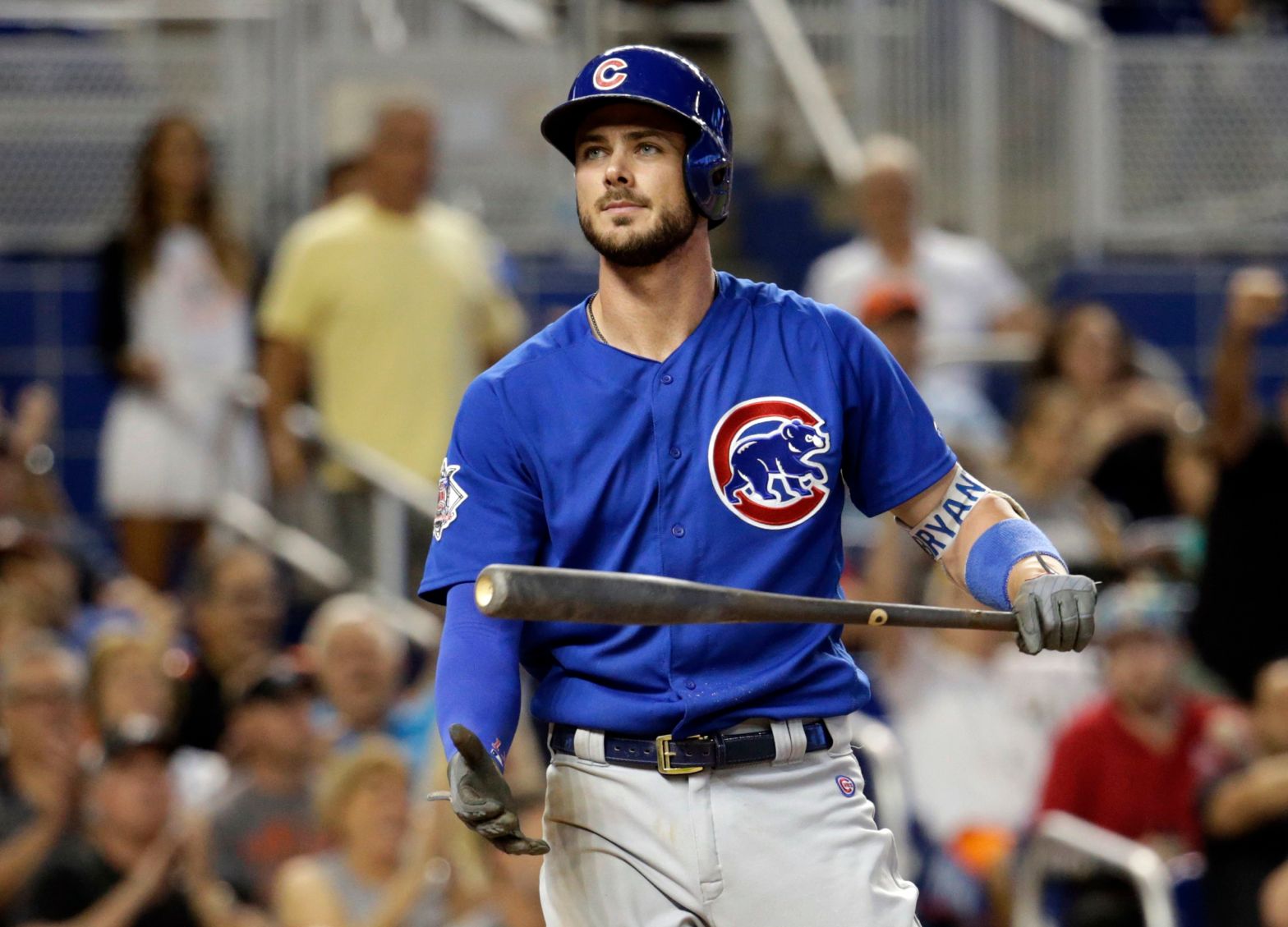
Unfortunately, it seems LeMahieu is more likely to re-sign with the Bronx Bombers, so the Nats will have to look elsewhere, despite Juan Soto’s interest in LeMahieu. Now, talks about trading for Cubs’ third baseman Kris Bryant have intensified.
I think going down that path would be a mistake.
Playing Carter Kieboom at third base was a failed experiment in 2020, and the Nats need better bats in the lineup to supplement Soto and Trea Turner. Enter Bryant, the 2016 NL MVP who played an instrumental role in ending the Cubs’ 108-year World series drought.
The Las Vegas native will turn 29 in January, and he will make around $18 million this year in his final season before hitting free agency. Since his meteoric rise in 2015-16, Bryant has been up and down; he had a solid year in 2017 before taking a step back in 2018. He returned to form in 2019 with 31 home runs, 77 RBI and a .282/.382/.521 slash line, which is the type of production the Nats would really benefit from.
2020 was a different story; Bryant played just 34 of a possible 60 games and hit just four home runs and 11 RBI. He struck out 40 times and hit a horrendous .206. Obviously the sample size was much smaller, and he did deal with injuries, but those numbers translate to about 18 home runs, 52 RBI and 176 strikeouts across 150 games. To put that into perspective, Bryant’s career-lows are 13 home runs and 52 RBI, and his career-high 199 strikeouts led the NL in 2015.
Not only that, but Bryant can also be a liability defensively. He finished with a .947 fielding percentage in 2019, the lowest among eligible major league third basemen that year. He has obviously proven he can play third base at an MVP level and hold down the fort on the hot corner, but if his offensive game continues to decline, his defensive performance could turn ugly fast.
Those are just a handful of basic stats that don’t paint the full picture, but clearly Bryant was not on the upswing in 2020. In such an abnormal year, his performance is less of a red flag than it would be in a full season, but it still isn’t encouraging. It is very possible Bryant resurges in 2021, especially if it’s in a new environment, but it’s no guarantee.
So Bryant isn’t as great as he was five years ago, but does Washington have any better alternatives? Thrusting Kieboom back at third won’t happen, at least not full time, and Asdrúbal Cabrera is 35 years old and a free agent. LeMahieu could theoretically play third if signed, or Starlin Castro could move to third while LeMahieu plays second, but none of that matters if LeMahieu doesn’t sign here.
I mentioned Justin Turner as a free agent choice last month, but his chances of signing in DC are even slimmer than LeMahieu’s at this point. Looking at all the options, Bryant would still be the best play at third by far. Despite the concerns, he’s a proven everyday third baseman, and unless his offensive numbers completely fall off a cliff like they did in 2020, then he would improve the lineup.
His experience in left field could also help the team throughout the season as a fill-in for any injuries or lineup shuffling. His $18 million salary is also less than Anthony Rendon’s $35 million average annual value (AAV) and Josh Donaldson’s $21 million, and both were on the Nationals’ radar a year ago. (Of course Rendon was already on the Nats, but they were looking to re-sign him.)
Looking at it purely from a personnel perspective, Bryant would be a figurative and literal home run acquisition for this team. However, there is more than one perspective when it comes to evaluating signings and trades, and the others suggest the Nats may want to pass on him.
Bryant’s contract status and the Nationals’ farm system put a major stink on a potential trade. Bryant’s $18 million sounds nice, but as a free agent next year with Scott Boras as his agent, Bryant will command much more. Granted, if his poor play from 2020 carries over to 2021, he likely won’t receive a huge salary bump, but then in that scenario, he wouldn’t be worth paying what he’d receive on the open market.
With Mike Rizzo’s track record with premium non-pitcher free agents, it’s likely Bryant could walk after just one season, which leads to the other problem: what it would take to bring him here.
Bryant is not a free agent, so he would have to be acquired by trade, which would require shipping out prospects. Washington’s farm system is depleted and low rated as is (no Nats prospects are ranked in the MLB Top 100 this year), and bringing in a player of Bryant’s caliber would require parting ways with high-level prospects.
The Nats are reportedly “determined” to keep their top two prospects, Jackson Rutledge and Cade Cavalli, but with other suitors in the trade market for Bryant’s services, a deal would require one or both of those pitchers to outbid the other teams.
Kieboom was an enticing piece a year ago, but he tanked all of his trade value this season. He still has hope of making it in the majors, but he needs more time. He is no longer a headlining prospect in a trade package.
With Max Scherzer’s getting up there in age, the Nats will need one or both of those guys to come in and succeed in order to keep the team competitive once Scherzer departs or retires. That’s still a few years away (if Scherzer re-signs in 2022), but shipping those guys away for one season of Bryant is not worth it.
Even if Bryant comes to Washington, re-signs the following year and stays in DC on a long-term contract, he will be 30 in 2022, and any contract that keeps him with the Nats will pay him big money well into his mid-to-late 30s.
The Nats will see Turner hit free agency in 2023, and Soto and Victor Robles will follow in 2025. Bryant’s contract would extend through all of that, and make it more difficult to retain one or more of those key players.
There’s no doubt Bryant would make the Nationals a better team in 2021, but at what cost? Worth giving up our top prospects in an already weak system? Worth trading for just one season of his service? Or instead, worth throwing a big contract at him at the risk of him declining even further? Worth losing one of Turner, Soto or Robles? I don’t think so.
The options at third base beyond Bryant are slim, but with everything they could lose, it’s in their best interest to explore the alternatives.
Cover Photo Credit: Lynne Sladky/AP
 The Wildcard